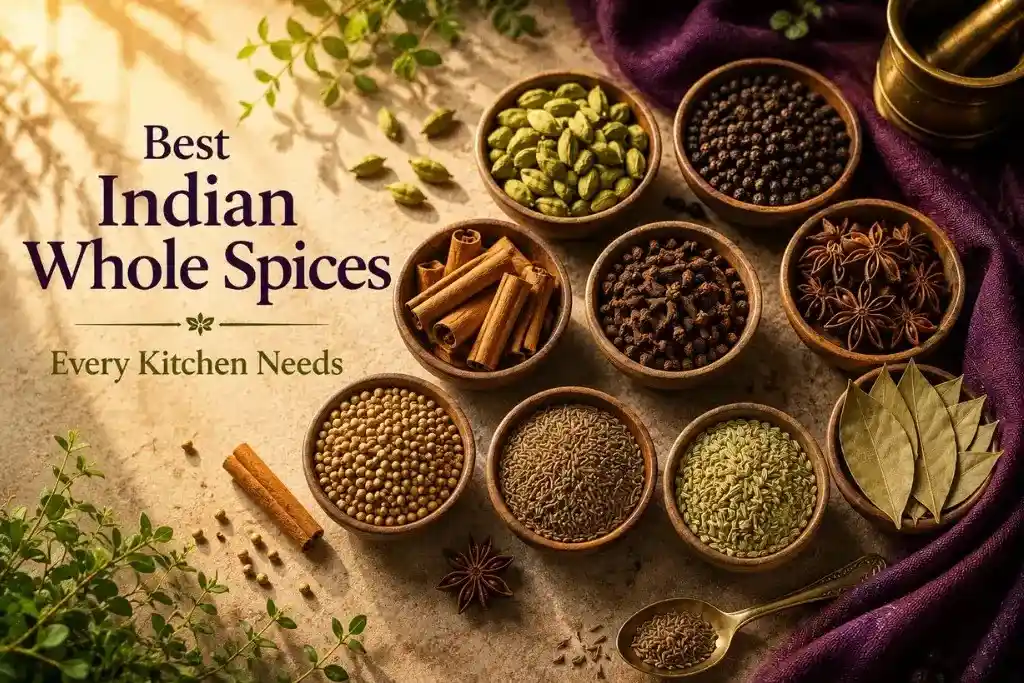
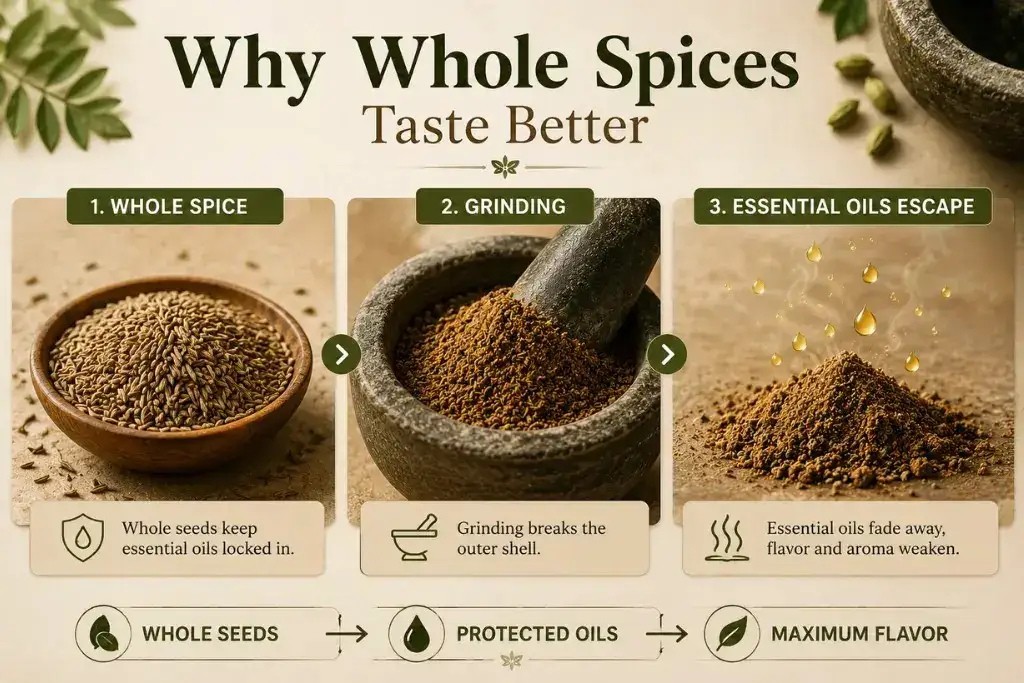
Every whole spice seed, pod, or bark contains volatile essential oils sealed inside its intact cell structure. These oils are the actual source of flavour, aroma, and most of the associated health properties. The diversity and quality of whole spices India produces across its growing regions, from the Thar Desert belts of Rajasthan to the high-altitude hills of Kerala and Meghalaya, is unmatched anywhere in the world. Cuminaldehyde gives cumin its sharp, warm character. Piperine gives black pepper its heat. Eugenol gives cloves their intensity. 1,8-cineole gives cardamom its distinctive freshness.
The moment a spice is ground, that sealed structure breaks. The essential oils begin to volatilise immediately, exposed to oxygen and light. Research on spice volatile oil degradation consistently shows that ground spices lose between 60 and 80 percent of their aromatic volatile content within 6 to 12 months of grinding, depending on storage conditions. Premium whole spices, stored correctly, retain the majority of their volatile oil content for 3 to 5 years.
The practical implication for daily cooking is straightforward. You need less of a high-quality whole spice to achieve the same or stronger flavour. You also have full control over when you release those oils, since tempering and dry-roasting extract oil from the intact seed at the moment of cooking, not weeks before it reaches your pan.
The 2026 Professional Kitchen Pantry Assessment
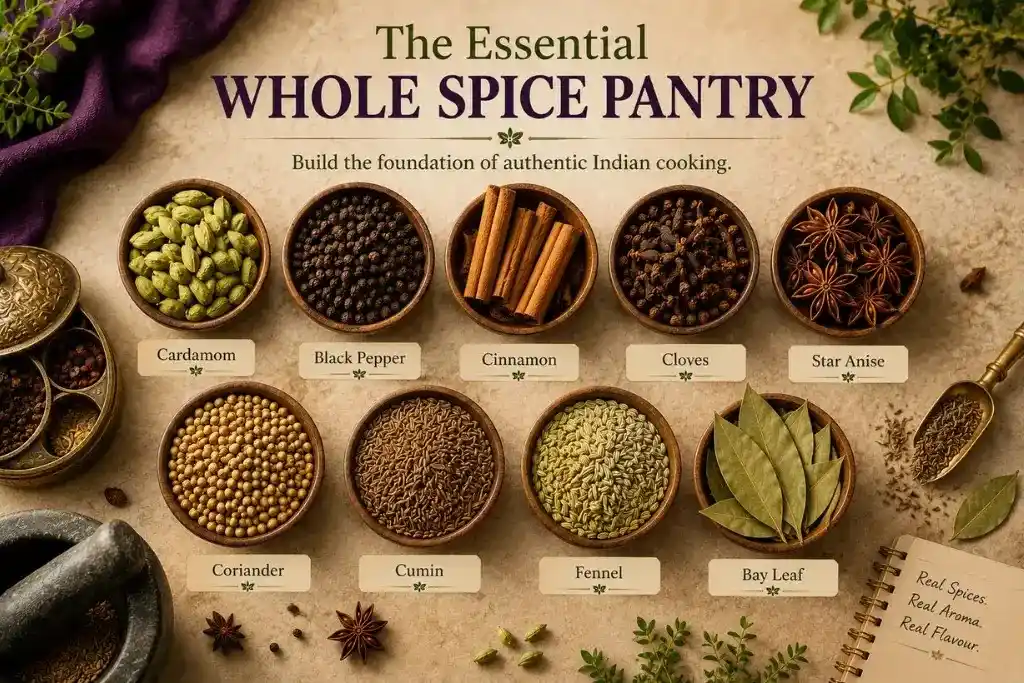
- Grade Standard: A premium khada masala list creates a solid base for preparing complex regional dishes.
- Authenticity Lock: Using unground sabut masala India leads your kitchen to exclude filler materials present in cheap powder.
- Essential Names: Knowing the standard Indian whole spices names is the only way you can find your way through specialized recipes easily.
- Blend Foundation: A fine-tuned whole garam masala spices blend has a richer flavor than pre-blended boxes.
- Sourcing Habit: Mastering the art of whole spices buying online India channels offers direct contact with certified batches.
- Quality Benchmark: Demanding documented, non-irradiated top whole spices assures highest retention of volatile oils.
Why whole spices outperform ground in the kitchen
- No fillers: Whole, unground sabut masala cannot be bulked with starch, bark powder, or synthetic additives the way ground spices can. What you see is what is in the jar.
- Longer shelf life: Properly stored whole spices retain full potency for 3 to 5 years. Ground spices begin losing volatile oil content within 6 months of grinding.
- Flavour control: You decide when the oil releases. Whole cumin in hot oil gives you a different flavour result than ground cumin added to a finished sauce.
- Purity verification: Visual and sensory checks on whole spices are far more reliable than on powders where adulteration is nearly impossible to detect by eye.
The Core Khada Masala List: Essential Indian Cooking Spices
The khada masala list refers to the set of whole spices used as the foundational flavour base for Indian cooking. Knowing the Indian whole spices names and understanding what each one does in the kitchen is the starting point for any serious cook. The following are the essential categories from the sabut masala India has produced for centuries, with notes on origin, primary compounds, and function in the kitchen.
Whole Black Pepper (Kali Mirch)
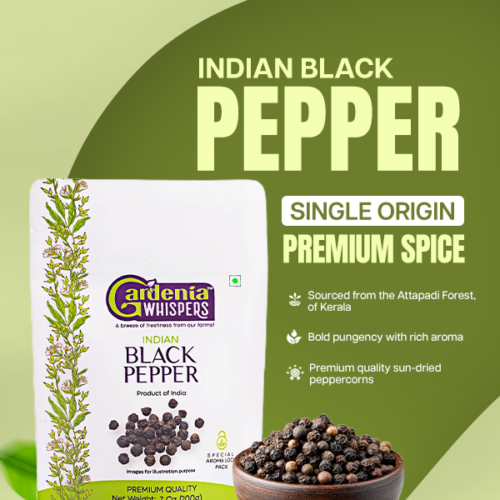
Black pepper from the Malabar Coast and Wayanad district of Kerala is among the most studied spices in food chemistry. Its primary active compound, piperine, contributes heat and also significantly increases the bioavailability of other compounds, including curcumin from turmeric, when consumed together.
For tempering, black peppercorns go into hot oil early. They benefit from slightly longer contact with fat to mellow their raw sharpness into a cleaner, more rounded heat. Whole peppercorns for grinding should be heavy and firm when pressed between fingers. A peppercorn that feels light or collapses easily was harvested before full maturity and will have low piperine concentration.
Shop our Indian Black Pepper.
Green Cardamom Whole (Elaichi)
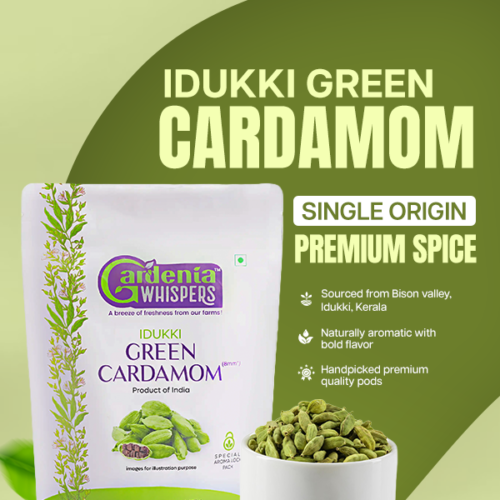
Cardamom grown in the Idukki hills of Kerala, at altitudes between 900 and 1,500 metres, develops under a specific combination of humidity, shade canopy, and altitude that produces pods with a high 1,8-cineole content. This compound gives Idukki cardamom its distinctive fresh, cooling, slightly camphoraceous quality.
The pods should be olive-green in colour. Pale or bleached pods indicate either post-harvest processing that strips the colour or lower-altitude growing conditions that produce a weaker seed. In cooking, cardamom pods are added early alongside heavy bark spices like cinnamon and cloves. For sweets and chai, crack the pod open and use only the seeds, which contain the highest concentration of essential oil.
Shop our Idukki Green Cardamom.
Whole Cloves (Laung)
Cloves from Kanyakumari in Tamil Nadu are grown at India’s southernmost tip, where the combination of coastal humidity and volcanic soil produces a high-eugenol yield. Eugenol, which makes up 70 to 90 percent of clove essential oil, delivers a strong, intensely aromatic character.
In tempering, cloves go in with the oil at the same time as cardamom and cinnamon. Their oils release quickly. Use them with restraint: one to two per portion of dal or curry is sufficient. For biryani and slow-braised preparations, three to four per serving is appropriate.
Shop our Kanyakumari Whole Cloves.
Whole Coriander Seeds (Dhaniya)
Coriander grown in Ramganjmandi, Rajasthan produces seeds with a rounded, citrusy, gently sweet flavour profile. The primary aromatic compounds are linalool and geranyl acetate, which give coriander its characteristic clean, slightly floral warmth.
Whole coriander seeds are used in tempering for dals and vegetable dishes. They are also dry-roasted and coarsely ground for chutneys and marinades. Among the sabut masala staples, they have the broadest application across regional Indian cooking.
Shop our Ramganjmandi Coriander.
Star Anise (Chakri Phool)
Star anise contains trans-anethole as its primary flavour compound, producing a distinctive deep, sweet anise flavour. Unlike most other whole spices, star anise is used primarily in slow-cooked preparations: biryani, nihari, slow-cooked lamb, and some Chettinad dishes. Its volatile oils are released gradually over longer cooking times, so it does not perform well in fast tempering. Add it to the oil at the start of a slow-cooked dish and allow it to simmer throughout.
The Seeds of Flavour Difference
Your choice of spice origin directly determines the flavour intensity of what ends up in your food. Single-origin spices from named growing regions carry measurably different compound concentrations than commodity blends.
Whole coriander seeds from Ramganjmandi add a citrusy, slightly sweet undertone that generic coriander does not reliably deliver. Black pepper from Wayanad carries a clean, piney piperine-forward heat that commodity pepper, often a blend of multiple untracked origins, rarely matches. Cardamom from Idukki, grown under forest canopy at altitude, produces a depth of 1,8-cineole that lower-altitude cultivations simply cannot replicate.
A single star anise added to the oil at the start of a slow-cooked dish delivers a sweet, warming depth that integrates into the entire preparation. These are not subtle differences. They are the difference between food that tastes like home cooking and food that tastes like it came from a kitchen that understood its ingredients.
Advanced Sourcing: Identifying Real Quality in an Adulterated Market
Spice adulteration is a documented problem. FSSAI surveillance data has found adulteration rates ranging from 20 to over 60 percent in spot testing of common spice categories. Knowing how to evaluate visual and sensory cues is the first line of defence before you even consider laboratory verification.
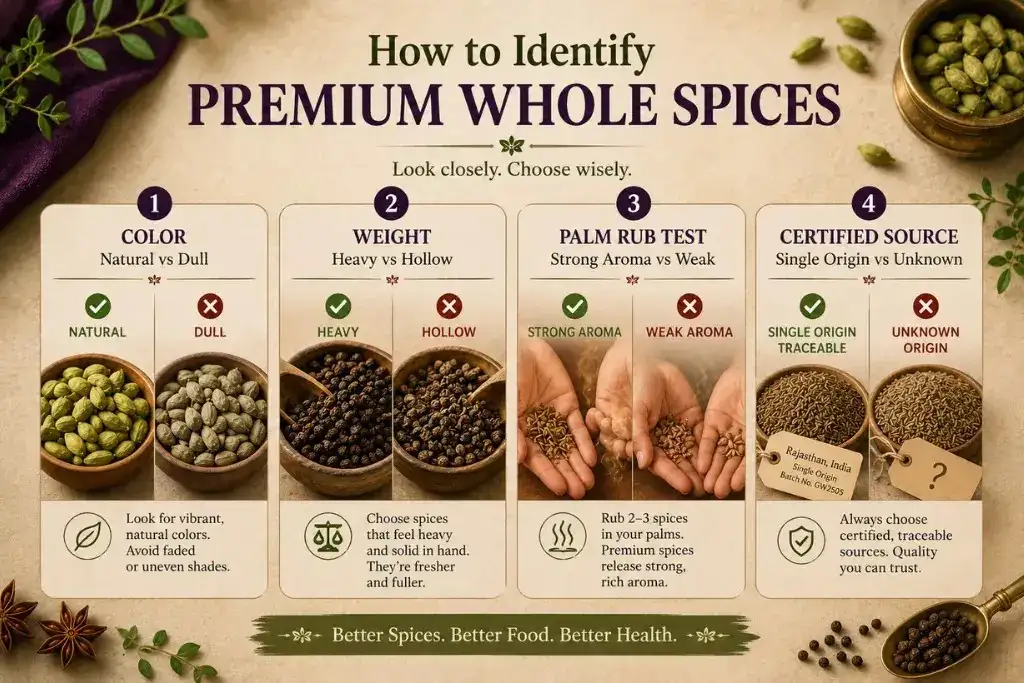
Identifying genuine quality: what to look for
- Colour: Whole coriander seeds should be uniformly golden-tan with no dark patches. Cardamom pods should be naturally olive-green, not bleached or artificially brightened. Any deviation is a signal.
- Weight and fullness: High-quality peppercorns feel firm and heavy when pressed between fingers. A peppercorn that collapses easily was harvested before maturity and has low piperine content. The same principle applies to other seeds: dense and full indicates proper maturity and high oil content.
- Scent test: Rub two or three seeds between your palms and smell immediately. A fresh whole spice from a good source releases a clear, defined aroma within seconds. If the response is faint, musty, or absent, the essential oil content has degraded.
- Certification: An FSSAI licence number on the packaging is a minimum requirement. NABL-accredited laboratory testing documentation means the spice has been independently verified against over 230 quality parameters by a government-recognised laboratory.
Sourcing regions: why origin specificity matters
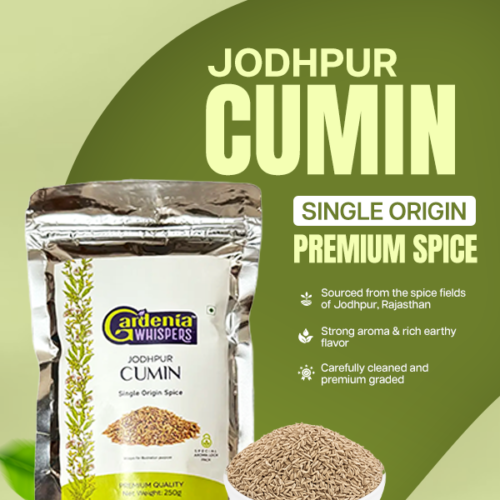
Rajasthan spices, particularly cumin and coriander from the Jodhpur and Ramganjmandi belts, develop under conditions of high heat, sandy-loam soil, and limited moisture that concentrate volatile essential oils in the seed. The same species grown in more temperate conditions produces a less potent seed with lower compound concentration. This is why named-origin sourcing matters more than generic product of India labelling.
When buying whole spices, look for brands that name the specific district or growing region, not just the state or country. Idukki for cardamom. Jodhpur for cumin. Kanyakumari for cloves. Ramganjmandi for coriander. Lakadong for turmeric. These are verifiable claims that can be traced back to a specific geography and farming community.
Mastering the Tadka: The Correct Technique for Flavour Release
Tempering, called tadka in Hindi, baghar in some regional variations, or chhonk in others, is the method by which whole spice essential oils are extracted into fat. The fat acts as a solvent for the oil-soluble aromatic compounds, dispersing them through the dish.
The temperature matters significantly. Fat heated to 160 to 180 degrees Celsius is the range where most whole spices release their oils effectively without burning. Below 150 degrees Celsius, extraction is slow and incomplete. Above 200 degrees Celsius, the more delicate aromatic compounds degrade before they can contribute to flavour.
How to Build a Whole Garam Masala Blend
A whole garam masala spices blend added to slow-cooked dishes rather than pre-ground powder delivers a different, more integrated aromatic profile. A standard whole garam masala composition:
- 4 to 5 green cardamom pods
- 1 piece of cinnamon bark (2 to 3 cm)
- 4 to 5 cloves
- 1 teaspoon whole black peppercorns
- 1 black cardamom pod (for smoky depth in meat dishes)
- 1 star anise
- 1 bay leaf
These go into the oil at the start of a biryani, korma, or slow-braised preparation. The heavy bark spices go in first: cinnamon and cloves. Cardamom pods follow after 15 to 20 seconds. The oils in each spice infuse the fat gradually, building a more integrated base than ground garam masala added late in cooking.
You can read more about how we source each of these spices at our how we source page.
Spice Reference: Compounds, Origins, and Oil Timing
| Spice | Primary Compound | Named Origin | Optimal Oil Timing |
|---|---|---|---|
| Green Cardamom | 1,8-Cineole, Linalool | Idukki, Kerala | Early, with heavy woody barks |
| Whole Coriander Seeds | Linalool, Geranyl Acetate | Ramganjmandi, Rajasthan | Midway, after cumin has released |
| Whole Black Pepper | Piperine | Wayanad/Malabar, Kerala | Early, to mellow raw sharpness |
| Star Anise | Trans-Anethole | Northeast India | Slow-cooked dishes only, simmered throughout |
| Cumin (whole) | Cuminaldehyde | Jodhpur, Rajasthan | After pepper and cloves, 30 to 40 seconds |
| Cloves | Eugenol | Kanyakumari, Tamil Nadu | Early, with cardamom and cinnamon |
How to Store Whole Spices: Protecting Volatile Oil Content
Correct storage conditions are the difference between a spice that delivers 90 percent of its original potency after three years and one that is functionally inert in 12 months.
Container: Use airtight glass jars with rubber-sealed lids. Avoid plastic containers, which are permeable to aromatic compounds and cause spices to lose potency faster. Avoid open dishes, wooden boxes, or paper bags for anything stored longer than a week.
Light exposure: Store spices in a dark cabinet or pantry. UV light degrades the terpene chains in essential oils. Even opaque plastic bags offer less protection than dark glass.
Humidity: Keep whole spices in an area with less than 60 percent relative humidity. The kitchen shelf directly above the stove is one of the worst storage locations due to steam and heat cycling.
Temperature: Consistent temperatures between 15 and 22 degrees Celsius are ideal. Refrigeration is acceptable for long-term storage of whole pods like cardamom and star anise.
Labelling: Write the purchase date on every jar. Whole peppercorns and cloves purchased from a certified, properly handled source retain full potency for up to 4 to 5 years. Coriander and cumin seeds are best used within 3 years. Star anise within 2 to 3 years.
Final Thoughts
Shifting your home kitchen toward using only unprocessed seasoning ingredients is a very significant step toward positively impacting your family’s health and culinary pleasure. By switching to robust raw seeds instead of easily available pre-ground powders, you unlock the true chemical value of ancient culinary methods. Loving the purity and nature of ingredients leads to food that is full of life, that smells powerfully, and that connects us to centuries of Indian spice culture.
At Gardenia Whispers, we source directly from GI-tagged and traditionally recognised growing regions across India: cumin and coriander from the Jodhpur and Ramganjmandi belts of Rajasthan, cardamom from Idukki in Kerala, cloves from Kanyakumari in Tamil Nadu, and turmeric from Lakadong in Meghalaya. Every farmer’s samples undergo over 230 tests at an NABL-accredited laboratory before we finalise any sourcing relationship. We are a US FDA Registered Facility operating under FSSAI licence. When you buy whole spices online India deserves a brand that can name the district, show the test report, and trace the batch back to the farm. The full sabut masala India range is available at our shop. For bulk enquiries, visit our bulk order page. You can read more about our sourcing standards at our quality promise page and certifications page.
Key Takeaways
- Volatile oil longevity: Whole spices retain 3 to 5 years of potency. Ground spices lose 60 to 80 percent of volatile oil content within 6 to 12 months of grinding.
- Purity verification: Whole spices can be evaluated visually and by scent. Ground spices cannot. Adulteration is far harder to detect in powder form.
- Origin specificity: Named growing regions (Jodhpur, Idukki, Kanyakumari) indicate measurably different compound concentrations than generic commodity sourcing.
- Tempering control: Whole spices give you precise control over when essential oils are released into fat, which ground spices added at the end of cooking cannot replicate.
- Lab verification: NABL-accredited testing is the only reliable third-party verification of purity, compound concentration, and adulterant absence.
Frequently Asked Questions on Indian Whole Spices
What is the difference between khada masala and ground spice in Indian cooking?
Khada masala refers to whole, unground spices used in their intact form. The essential oils responsible for flavour are sealed inside the seed structure and released during cooking through tempering in hot oil or long simmering. Ground spices release their oils immediately but also lose them quickly through oxidation after grinding. Whole spices give you direct control over when and how the flavour is extracted into your dish.
Which whole spices should every Indian kitchen have?
The core khada masala list for everyday Indian cooking includes whole cumin, black peppercorns, green cardamom pods, cloves, whole coriander seeds, and cinnamon bark. These six cover the tempering requirements for the vast majority of North and South Indian regional cooking. Star anise, fenugreek seeds, fennel seeds, and bay leaves are worth adding if you cook biryanis, slow-braised preparations, or regional dishes from Bengal and Rajasthan.
How do I know if my whole spices are still good?
Rub two or three seeds between your palms and smell immediately. A fresh whole spice releases a clear, defined aroma within a few seconds. If the smell is faint, flat, or absent, the essential oil content has degraded and the spice will not contribute meaningful flavour. Visual checks also help: cumin seeds should be uniform and elongated, cardamom pods should be olive-green rather than pale, and peppercorns should feel firm and heavy when pressed between fingers.
What is the correct oil temperature for tempering whole spices?
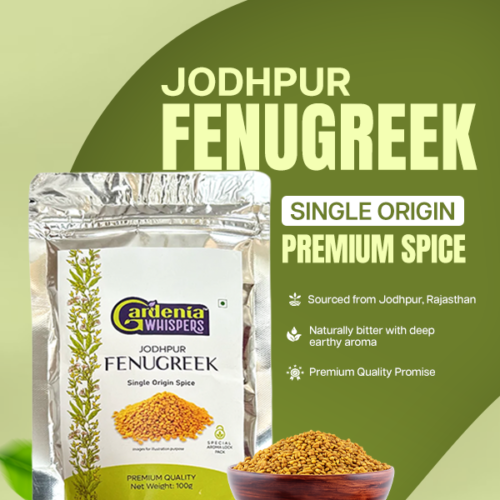
Between 160 and 180 degrees Celsius. This range extracts essential oils efficiently without burning the more delicate aromatic compounds. If the oil is visibly smoking, it is too hot. If the spices do not sizzle immediately when added, the oil is not hot enough. The sequence matters too: heavy spices like black pepper and cloves go in first, followed by cardamom and cinnamon, then cumin. Coriander and fenugreek go last as they burn more quickly.
Are whole spices from India adulterated?
Adulteration is a documented problem. FSSAI surveys have found adulteration rates ranging from 20 to over 60 percent in spot testing of common spice categories including cumin, turmeric, and coriander. Whole spices are generally harder to adulterate than ground spices because visual and sensory checks are more reliable. However, adulteration with visually similar seeds does occur. Grass seeds mixed into whole cumin is a common example. Buying from brands that publish NABL-accredited laboratory testing documentation and FSSAI licence numbers provides the most reliable protection. You can read about how Gardenia Whispers tests every farmer’s samples at our quality promise page and certifications page.
Why do Rajasthan spices taste stronger than spices from other regions?
Spices from the arid growing regions of Rajasthan, particularly cumin and coriander from the Jodhpur, Barmer, and Ramganjmandi belts, develop under conditions of high heat, sandy-loam soil, and limited moisture. These conditions force the plant to concentrate its volatile essential oils in the seed as a stress response. The same species grown in more temperate, moisture-rich conditions produces a less potent seed. Jodhpur cumin, for example, has measurably higher cuminaldehyde concentrations than commodity cumin from other regions. This is the principle behind GI tagging and single-origin sourcing.
How long do whole spices stay potent if stored correctly?
Stored in airtight glass jars away from light, heat, and humidity, whole spices retain the majority of their volatile oil content for the following periods: whole peppercorns and cloves 4 to 5 years, cardamom pods and cinnamon bark 3 to 4 years, cumin and coriander seeds 3 years, and star anise 2 to 3 years. The shelf above the stove is one of the worst storage locations due to heat cycling and steam. A dark cabinet or pantry is ideal. Label each jar with the purchase date.
Where can I buy premium single-origin whole spices in India?
When buying whole spices online in India, look for brands that name specific origin regions rather than just “product of India”, publish their FSSAI licence number on packaging, and provide NABL-accredited laboratory testing documentation. Gardenia Whispers sources directly from GI-tagged origin regions including Jodhpur for cumin, Idukki for cardamom, Kanyakumari for cloves, and Ramganjmandi for coriander. Every farmer’s samples go through over 230 lab parameters before the sourcing relationship is confirmed. You can start with our single-origin trial pack or browse the full range at our shop.

Farm-Fresh Jodhpur Cumin Seeds – Rajasthan’s Finest Jeera
Price range: ₹65.00 through ₹175.00 incl. GSTClear40 g100 g250 gSelect options This product has multiple variants. The options may be chosen on the product pageJodhpur Fenugreek Seeds – Pure Rajasthani Methi
Price range: ₹35.00 through ₹65.00 incl. GSTClear50 g100 gSelect options This product has multiple variants. The options may be chosen on the product pageMalabar Peppercorn- Indian Wayanad Black Pepper from Kerala
Price range: ₹145.00 through ₹415.00 incl. GSTClear50 g100 g200 gSelect options This product has multiple variants. The options may be chosen on the product pagePremium Idukki Green Cardamom
Price range: ₹385.00 through ₹1,390.00 incl. GSTClear40 g100 g200 gSelect options This product has multiple variants. The options may be chosen on the product page