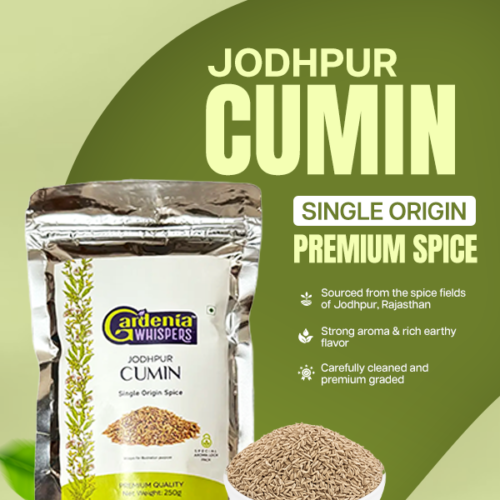
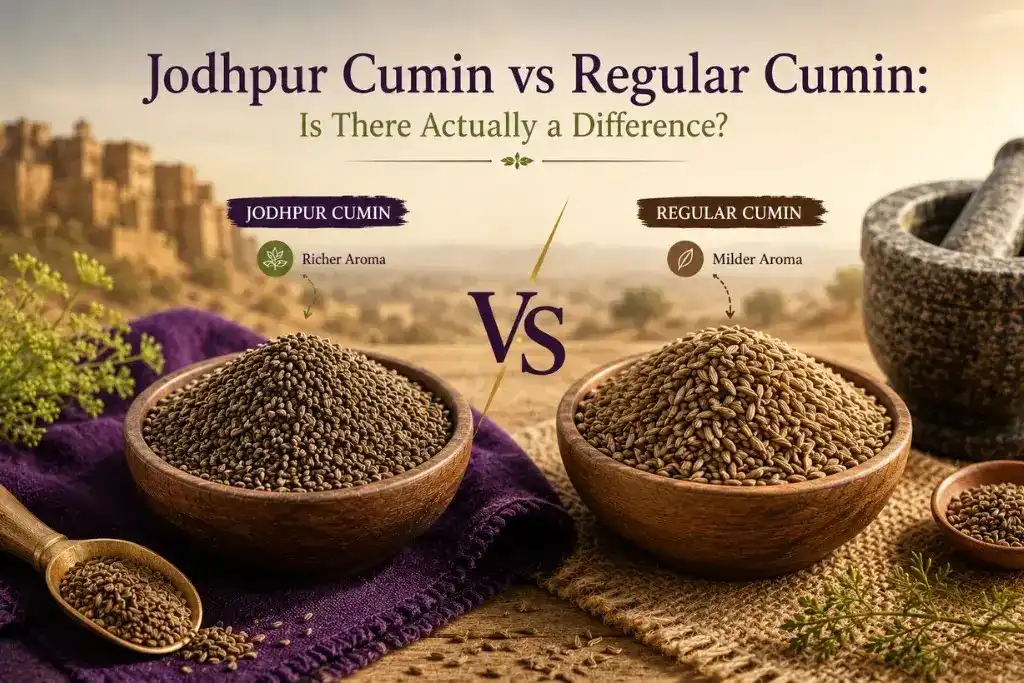
If you think all cumin seeds are the same, you are missing the one factor that separates a good Indian dish from a great one: origin. Most markets treat jeera as a generic commodity, interchangeable regardless of where it was grown. But when you compare Jodhpur cumin vs regular cumin, the difference is not a matter of marketing. It is measurable chemistry.
Regular cumin, as sold in most supermarkets and through commodity suppliers, is typically a blend sourced from multiple untracked origins. These include large-scale cultivation areas in Gujarat aggregated through the Unjha market, and imported cumin from Iran and Syria. Blending across origins normalises the product for visual consistency and price, but strips away the regional character that makes single-origin cumin valuable. Cuminaldehyde content in commodity cumin typically falls between 2 and 3 percent of volatile oil weight.
Jodhpur cumin, grown in the Jodhpur, Barmer, and Nagaur districts of Rajasthan, is a different product. The sandy-loam, alkaline soils of the Thar Desert, combined with extreme temperature variation between day and night during the growing season and limited annual rainfall, force the cumin plant to concentrate its essential oils as a physiological stress response. The result is a seed with cuminaldehyde content typically ranging from 3 to 4.5 percent of volatile oil weight, a 50 to 100 percent higher concentration than commodity cumin. This is documented in food chemistry research on Cuminum cyminum L. volatile oil composition across Indian growing regions.
Understanding the Terroir: Why Rajasthan Jeera Stands Out
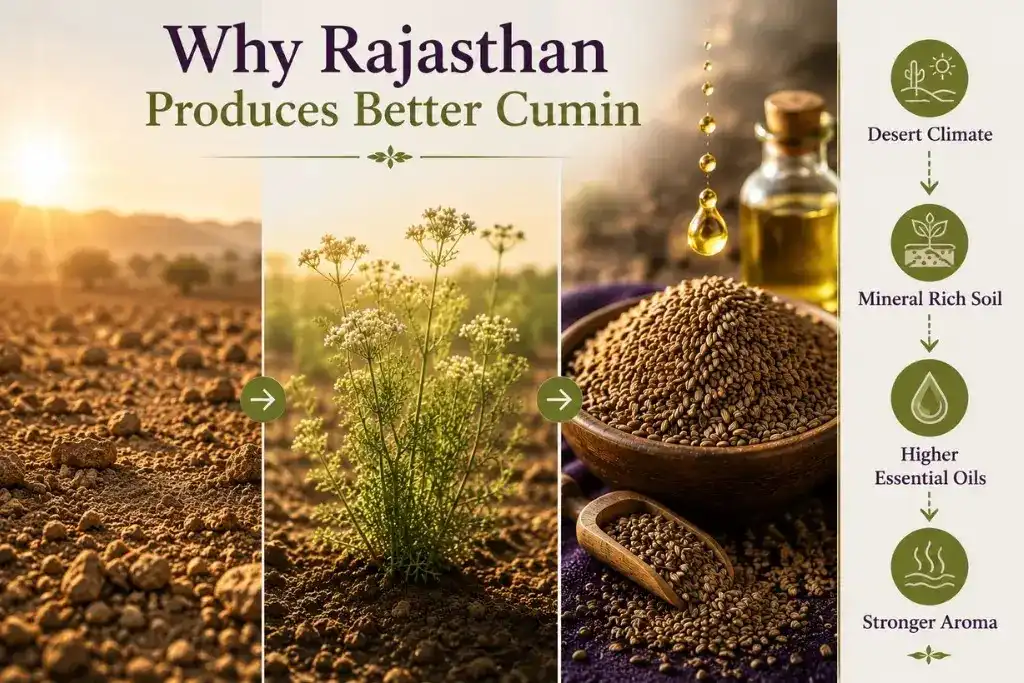
The word terroir is used in wine to describe how geography shapes the character of a crop. The same principle applies to Marwari jeera. The desert environment of western Rajasthan creates growing conditions that no irrigated, temperature-stable cultivation zone can replicate.
Daytime temperatures in the Jodhpur growing belt routinely reach 40 to 45 degrees Celsius during the cumin growing season, which runs from November to February. Nights drop sharply, sometimes by 20 degrees or more. This temperature cycling forces the cumin plant to produce protective volatile compounds in higher concentrations. The sandy-loam soil drains rapidly, keeping moisture stress high. Low annual rainfall, averaging 300 to 400 mm, means the plant never has access to the water that would dilute its oil production.
The result is a seed that is smaller and denser than cumin grown in well-irrigated conditions, with a measurably higher essential oil percentage and a flavour profile that is sharper, more defined, and less flat than commodity cumin. This is why Rajasthan jeera benefits extend beyond marketing language into actual sensory and chemical difference. If you want to understand more about how geography and soil determine spice quality across all our products, read about how we source.
Key Differences Between Jodhpur Cumin & Regular Cumin
Cuminaldehyde content: Jodhpur cumin carries 3 to 4.5 percent cuminaldehyde in its volatile oil profile. Commodity cumin from blended sources typically carries 2 to 3 percent. Cuminaldehyde is the primary compound responsible for cumin’s characteristic aroma and the digestive stimulation associated with cumin consumption.
Seed morphology: Jodhpur seeds are generally smaller and more compact than commodity cumin. The higher density reflects greater maturity and oil concentration at harvest.
Moisture content: Desert-grown cumin has naturally lower moisture content than cumin grown in irrigated conditions. Lower moisture reduces the risk of mould and extends shelf life without artificial drying.
Cumin aroma quality: The aroma of Jodhpur cumin is stronger and more defined. In tempering, the release of cuminaldehyde into hot oil is noticeably more intense. The flavour is less flat and less grassy than commodity cumin, with a cleaner, warmer finish. This difference in cumin aroma quality is what distinguishes premium whole cumin India produces in desert-growing regions from blended commodity alternatives.
Traceability: Single-origin Jodhpur cumin carries a named growing district. Commodity cumin typically cannot be traced to a specific origin because it is blended at aggregation points before sale. You can read about the verification standards we apply to every batch at our certifications page.
Unjha Cumin vs Jodhpur Cumin
Understanding the sabut jeera comparison between Unjha and Jodhpur requires understanding what Unjha is. Unjha is a trading market in Gujarat, not a growing region. It is the world’s largest spice trading hub, aggregating cumin from multiple cultivating states including Rajasthan, Gujarat, and Madhya Pradesh. Cumin sold through Unjha is blended, sorted for visual consistency, and graded for export.
A question many buyers ask is: where is jeera grown India, and which region produces the best quality? Cumin is grown commercially across Rajasthan, Gujarat, and parts of Madhya Pradesh. Rajasthan accounts for approximately 80 percent of India’s total cumin production, with the Jodhpur, Barmer, and Nagaur districts being the primary growing zones. From a flavour and volatile oil standpoint, the Jodhpur and Barmer districts consistently produce cumin with the highest cuminaldehyde concentrations due to their desert agroclimatic conditions. When evaluating the best jeera brand India has to offer, the origin district on the label is a more reliable quality signal than the brand name itself.
Unjha-grade cumin is consistent and reliable for commercial food production where uniformity matters more than regional character. It is what most packaged spice brands use. Jodhpur cumin sourced directly from the growing districts, without passing through commodity aggregation, retains its regional identity. The cumin volatile oil content has not been diluted by blending with lower-grade material from other regions.
How to Evaluate Cumin Quality Before You Buy
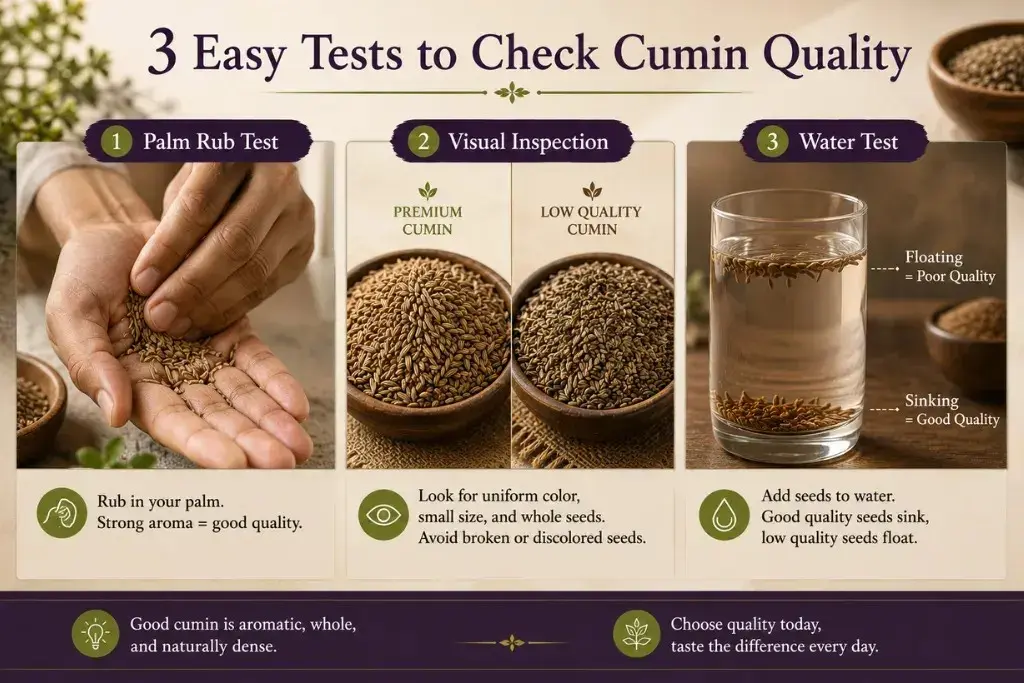
Palm rub test: Place a small quantity of seeds in your palm and rub firmly for 10 seconds. High cuminaldehyde content produces an immediate, strong aroma that stays on the skin for several minutes. If the aroma is faint or disappears within seconds, essential oil content has degraded.
Visual inspection: Genuine Jodhpur cumin seeds are greyish-brown, slightly ridged along the length, and uniform in shape. Avoid seeds that are very dark or appear shiny, as this can indicate charcoal coating used to mask age or inferior quality.
Water float test: A rough proxy for oil content. Place a small quantity in water. Mature, oil-rich seeds tend to sink. Seeds that float in large proportion are either immature or have had their essential oils depleted. This test is indicative, not definitive, and should be combined with the scent test.
Origin and lab documentation: The most reliable quality signal is a named growing district on the label, combined with NABL-accredited laboratory testing documentation and an FSSAI licence number. Visual tests confirm basic quality; lab testing confirms purity and compound content. You can read about how we test every farmer’s sample across over 230 parameters at our quality promise page.
Medicinal and Culinary Value: Why It Matters
The digestive properties associated with cumin in Ayurvedic tradition are attributed primarily to cuminaldehyde and thymol, both volatile compounds that stimulate bile production and support the breakdown of dietary fats. Higher cuminaldehyde content in Jodhpur cumin means these effects are more pronounced than in commodity cumin with lower compound concentrations.
In culinary use, the difference is most apparent in three applications. In tempering, higher-cuminaldehyde cumin releases more aromatic compounds into the fat, producing a stronger flavour base for the entire dish. In jeera pani, the infusion produced from genuine Marwari jeera is noticeably more aromatic and flavourful than one made from commodity cumin. You can find a detailed guide on making and using jeera water in our blog on jeera water for weight loss: benefits and recipe. In dry-roasting and grinding, the resulting powder retains its potency longer because it started with a higher volatile oil baseline.
Cumin also pairs naturally with other spices in most Indian tempering bases. Our Ramganjmandi coriander and Jodhpur fennel are sourced from the same Rajasthan growing belt under the same direct-source standards, and work alongside Jodhpur cumin in most tempering applications. For a broader guide on the health benefits specific to Jodhpur cumin, read our detailed post on the health benefits of Jodhpur cumin and sabut jeera.
Cumin also complements other spices with established health benefits. Fenugreek, another Jodhpur-grown spice in our range, is frequently combined with cumin in digestive preparations and traditional cooking. Our Lakadong turmeric, with its 7 to 12 percent curcumin concentration, pairs with cumin in many traditional formulations where piperine from black pepper and cuminaldehyde from cumin together increase curcumin bioavailability.
Final Thoughts
Deciding on the perfect spice means honoring where your ingredients come from. Although the use of regular cumin may be enough for the simplest seasoning, hardcore fans recognise the Jodhpur cumin vs regular cumin difference as a case of not only health but also superior taste. Instead of using the common commodity spice, which is highly blended, if you go for single-origin, terroir-focused products, it is not simply seasoning a dish; you are keeping a flavor tradition alive.
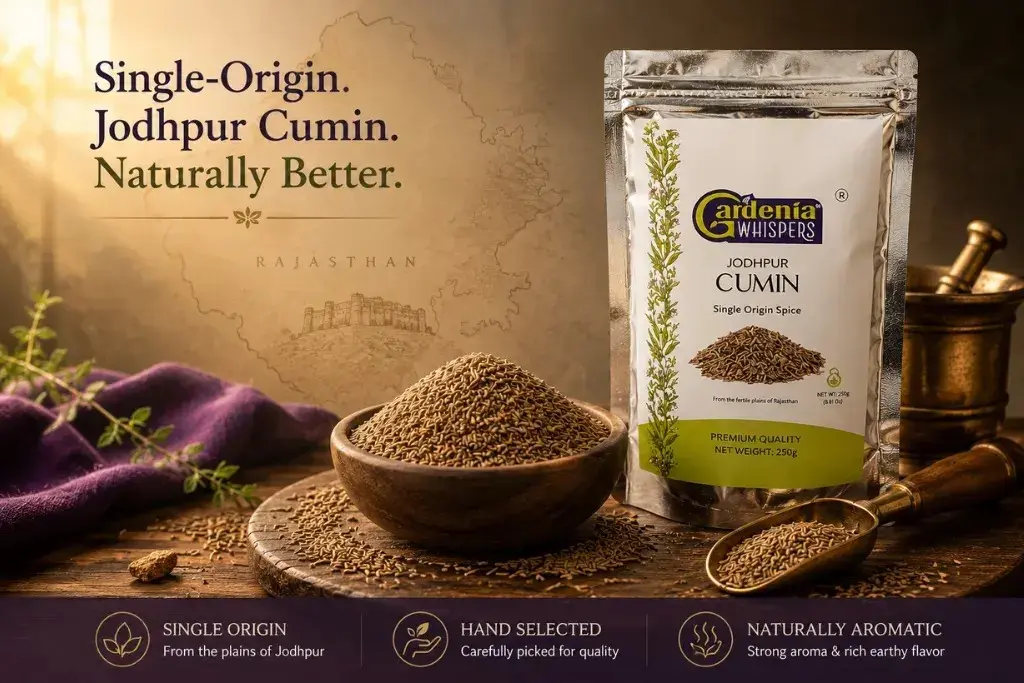
Our pride at Gardenia Whispers lies in the fact that, in reality, we connect the lifestyle of the arid, spice-rich fields of Rajasthan to your kitchen counter. We are not just selling seeds; we are giving you a taste of the experience that highlights the excellent cumin aroma quality of our crops. Our method is oriented towards maintaining the natural cumin volatile oil content, which makes Marwari spices so famous. By choosing Gardenia Whispers, customers are sure to be getting hand-selected, top-grade batches that have never undergone industrial stripping or chemical polishing. We encourage our customers to experience the intensity of the desert in each pinch of our genuine, farm-to-table products.
Key Takeaways
- Cuminaldehyde content is the key differentiator. Jodhpur cumin carries 3 to 4.5 percent cuminaldehyde versus 2 to 3 percent in commodity cumin. This is the measurable basis of the flavour and potency difference.
- Unjha is a trading hub, not a growing region. Cumin sold through Unjha can come from multiple states. Single-origin Jodhpur cumin sourced directly from the growing districts is a different product from Unjha-traded commodity cumin.
- Desert stress conditions drive oil concentration. The extreme heat, sandy-loam soil, and low rainfall of the Thar Desert force the cumin plant to produce more essential oil than irrigated, temperate cultivation zones can.
- Test before you trust. Palm rub, visual inspection, and water float test are useful basic checks. NABL-accredited laboratory documentation verified at our certifications page is the only reliable verification of compound content and adulterant absence.
- Whole seeds preserve potency. Ground cumin loses 60 to 80 percent of its volatile oil content within 6 to 12 months of grinding. Whole Jodhpur cumin stored correctly retains full potency for 3 years.
Jodhpur Cumin: Frequently Asked Questions
What is the actual difference between Jodhpur cumin and regular cumin?
The primary measurable difference is cuminaldehyde content. Jodhpur cumin, grown in the Jodhpur, Barmer, and Nagaur districts of Rajasthan, typically carries 3 to 4.5 percent cuminaldehyde in its volatile oil profile. Commodity cumin from blended sources typically carries 2 to 3 percent. Cuminaldehyde is the compound responsible for cumin’s characteristic aroma and its digestive properties. Higher concentration means stronger flavour, more pronounced aroma in tempering, and better potency in medicinal applications. The desert growing conditions of the Thar force the cumin plant to concentrate its oils as a stress response, which commodity cumin grown in irrigated, temperate zones does not undergo.
What is Marwari jeera and why is it considered premium?
Marwari jeera refers to cumin grown in the Marwar region of Rajasthan, which covers the Jodhpur, Barmer, and Nagaur districts. The term distinguishes this geographically specific variety from generic commodity cumin. It is considered premium because the sandy-loam desert soils, extreme temperature variation, and low annual rainfall of the Thar Desert produce seeds with measurably higher essential oil content than cumin grown in more temperate, irrigated conditions. The flavour is more defined, the aroma more intense, and the cuminaldehyde concentration significantly higher than in blended commodity jeera.
What is the difference between Unjha cumin and Jodhpur cumin?
Unjha is a trading market in Gujarat, not a growing region. It is the world’s largest spice trading hub, aggregating cumin from multiple cultivating states including Rajasthan, Gujarat, and Madhya Pradesh. Cumin sold through Unjha is blended, sorted for visual consistency, and graded for export. Jodhpur cumin sourced directly from the growing districts bypasses this aggregation and retains its single-origin regional character. When you buy through Unjha-grade channels, you are buying a consistent commercial product. When you buy direct-source Jodhpur cumin, you are buying the specific variety from a named growing district with traceable origin.
Where is jeera grown in India and which region produces the best quality?
Cumin is grown commercially across Rajasthan, Gujarat, and parts of Madhya Pradesh. Rajasthan accounts for approximately 80 percent of India’s total cumin production, with the Jodhpur, Barmer, and Nagaur districts being the primary growing zones. Gujarat, particularly around the Unjha belt, is the second major producing state. From a flavour and essential oil standpoint, the Jodhpur and Barmer growing districts of Rajasthan consistently produce cumin with higher cuminaldehyde concentrations due to their desert agroclimatic conditions.
How do I test cumin quality at home?
Three basic tests work well. First, the palm rub test: rub a small quantity of seeds firmly between your palms for 10 seconds. High-quality cumin releases a strong, defined aroma immediately that stays on the skin. Faint or short-lived aroma indicates depleted essential oil content. Second, the visual test: good Jodhpur cumin is greyish-brown, uniformly shaped with visible ridges. Very dark or shiny seeds may be coated with charcoal to mask age. Third, the water float test: a rough proxy for oil content. Seeds that sink tend to be denser and better matured. A large proportion of floating seeds suggests immature harvest or oil-depleted seeds. These tests are useful for a basic check. NABL-accredited laboratory testing is the only reliable verification of compound content and adulterant absence.
What are the Rajasthan jeera benefits compared to regular cumin?
The benefits attributed to cumin in traditional and Ayurvedic use, primarily digestive stimulation and bile production support, are linked to cuminaldehyde and thymol content. Jodhpur cumin carries higher concentrations of both compounds than commodity cumin. This means the digestive effect from jeera pani or cumin tempering is more pronounced with genuine Marwari jeera than with commodity alternatives. In culinary use, the higher cuminaldehyde content produces stronger flavour release in tempering, more aromatic grinding results, and better potency over the shelf life of the stored seed.
Is cumin from India commonly adulterated?
Cumin is one of the most commonly adulterated spices in the Indian market. FSSAI surveillance data has documented adulteration including grass seeds mixed with whole cumin to increase bulk weight, charcoal coating on old seeds to improve appearance, and in ground cumin, the addition of starch and other fillers. Whole cumin is harder to adulterate than ground because visual detection is more reliable. However grass seed adulteration does occur in whole jeera. The most reliable protection is buying from brands that provide NABL-accredited laboratory testing documentation, an FSSAI licence number, and named-origin sourcing. You can read about our testing process at our quality promise page and certifications page.
Where can I buy authentic Jodhpur jeera online with verified sourcing?
When buying authentic jeera online, look for three things: a named growing district (Jodhpur or Barmer, not just Rajasthan or India), NABL-accredited laboratory testing documentation, and an FSSAI licence number on packaging. Gardenia Whispers sources cumin directly from farmers in the Jodhpur and Barmer districts of Rajasthan. Every farmer’s samples undergo over 230 lab parameters before the sourcing relationship is confirmed.

Farm-Fresh Jodhpur Cumin Seeds – Rajasthan’s Finest Jeera
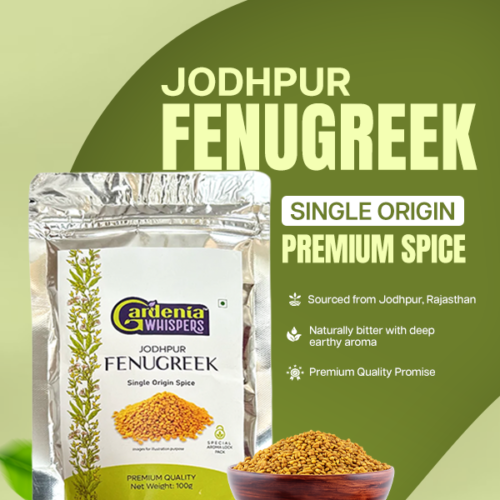
Price range: ₹65.00 through ₹175.00 incl. GSTClear40 g100 g250 gSelect options This product has multiple variants. The options may be chosen on the product pageJodhpur Fenugreek Seeds – Pure Rajasthani Methi
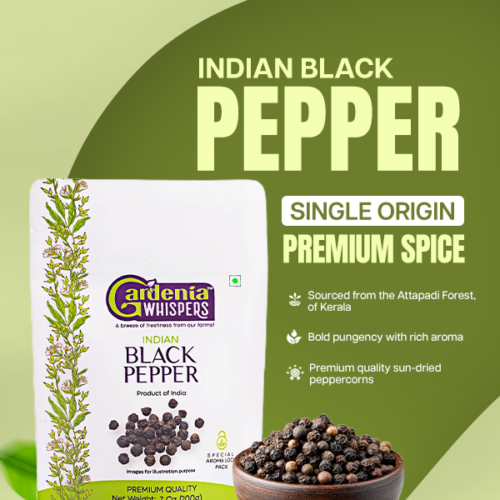
Price range: ₹35.00 through ₹65.00 incl. GSTClear50 g100 gSelect options This product has multiple variants. The options may be chosen on the product pageMalabar Peppercorn- Indian Wayanad Black Pepper from Kerala
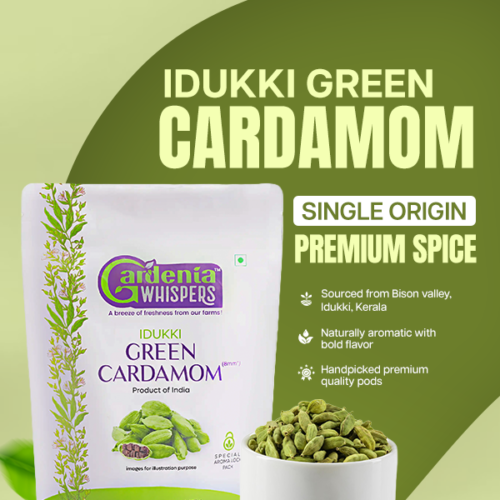
Price range: ₹145.00 through ₹415.00 incl. GSTClear50 g100 g200 gSelect options This product has multiple variants. The options may be chosen on the product pagePremium Idukki Green Cardamom
Price range: ₹385.00 through ₹1,390.00 incl. GSTClear40 g100 g200 gSelect options This product has multiple variants. The options may be chosen on the product page