India has a documented spice adulteration problem. The Food Safety and Standards Authority of India has found adulteration rates of 20 to 65 percent across common spice categories in retail market surveillance. That means a meaningful proportion of the turmeric, cumin, or coriander sold through unverified sources contains something other than what the label states.
This guide gives you a specific test for each of the 14 most commonly adulterated spices. Each entry follows the same structure: look, smell, touch, taste, and water or heat test where applicable. Each test tells you what to do, what genuine looks or smells or feels like, and what adulterated or depleted looks or smells or feels like. The challenge line at the end of this guide is the honest conclusion of every test in here.
One important note before you start. Home tests catch gross adulteration. They cannot catch synthetic dyes at sub-visual concentrations, pesticide residue, heavy metals, or precise compound levels like curcumin percentage in turmeric or cuminaldehyde in cumin. For those, NABL-accredited laboratory testing is the only reliable method. Read about what 230-parameter lab testing actually covers on our quality promise page.
What You Are Actually Buying: The Adulteration Problem in 14 Common Spices
These are the spices in this guide, why each one is included, and what makes each one a priority to test. All 14 are among the most commonly purchased Indian kitchen spices and all 14 appear in FSSAI surveillance data on food adulteration.
1. Turmeric / Haldi
Turmeric is the most adulterated spice in India. The two most common adulterants are Lead Chromate, a carcinogenic compound added to intensify colour, and Metanil Yellow, a banned synthetic dye. Both are used to make old, low-curcumin turmeric appear more potent and fresher than it is.
Look: Examine the powder in natural daylight. Pure turmeric has a warm, natural tone that looks like something grown in soil. Adulterated turmeric often appears unnaturally vivid, almost glowing, which is not how a dried root powder looks naturally.
Smell: Open the packet and smell directly. Genuine high-curcumin turmeric, particularly from Lakadong in Meghalaya, has a strong, slightly bitter, earthy aroma that fills the room. Low-curcumin or adulterated turmeric smells flat, weak, or has a faintly chemical note.
Cold water test: Stir one teaspoon into a glass of cold water. Do not stir again. Watch for 2 minutes. Pure turmeric disperses slowly and settles into a natural layer at the bottom. Adulterated turmeric with synthetic dyes releases streaks of vivid colour immediately that spread through the water before settling. The streaking is the tell.
HCl test for Metanil Yellow: Dissolve a small amount in water and add two or three drops of hydrochloric acid. If the mixture turns pink or magenta, Metanil Yellow is present. Pure turmeric with HCl shifts to a brighter version of its natural colour, not pink.
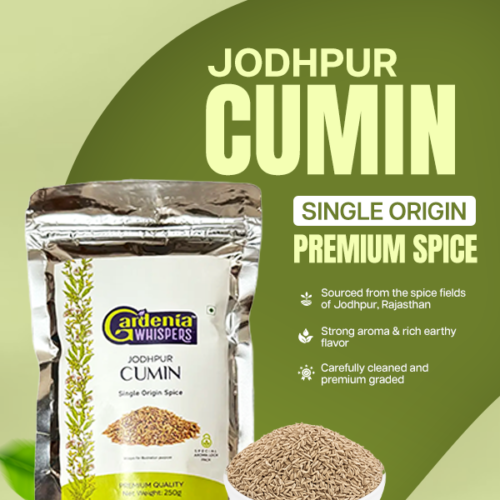
The two most common adulterants in whole cumin are grass seeds mixed in to increase bulk weight, and charcoal coating applied to old, oil-depleted seeds to make them appear fresh.
Look: Place a small quantity on white paper under good light. Genuine cumin seeds are elongated, roughly 5 to 6mm long, with five pale ridges running along the length. A grass seed adulterant is shorter, rounder, smoother, and noticeably smaller. The shape difference is visible within seconds. Any batch with seeds that do not match this shape profile is mixed.
Smell: Place a teaspoon in your palm, close your hand, and rub firmly for 10 seconds. Genuine high-cuminaldehyde cumin leaves a strong, warm, earthy, slightly sharp aroma on your skin that stays for several minutes. Faint or absent aroma means the cuminaldehyde content is depleted. This is the most reliable single test for cumin quality.
Touch: Run a small quantity through your fingers. Genuine mature cumin seeds feel firm and slightly dense. Exhausted seeds, from which essential oils have been commercially extracted, feel lighter and more hollow than fresh seeds of the same size.
Water test: Drop seeds into a glass of water. Oil-rich mature seeds tend to sink or hover just at the surface. A large proportion floating clearly indicates either immature seeds or exhausted seeds.
The most common adulterants in ground coriander are bark powder, dried organic waste material, and starch. In whole coriander, sand and small stones are added to increase weight.
Look (ground): Examine the powder closely. Pure ground coriander has a natural, slightly textured appearance with small variations. Heavily adulterated coriander may look unusually uniform, very fine, or slightly gritty depending on the adulterant used.
Smell: Rub whole seeds between your palms or open the ground coriander and smell directly. Genuine Ramganjmandi coriander releases a clean, citrusy, slightly floral aroma immediately. A flat, musty, or faintly chemical smell indicates old stock or adulteration.
Water settling test (ground): Stir one teaspoon of ground coriander into a glass of water and leave for 3 minutes without stirring. Pure coriander disperses fairly evenly with minimal visible sediment. Sand, chalk, and bark powder are heavier than coriander and settle visibly at the bottom. The amount of sediment tells you the amount of adulteration.
Iodine test for starch: Dissolve a small amount in water and add two drops of iodine. Deep blue or black indicates starch addition. Pure coriander shows little or no colour change from the iodine.
Our Ramganjmandi Coriander is sourced directly from Ramganjmandi in Rajasthan, the nationally recognised growing district for premium dhaniya.
4. Black Pepper / Kali Mirch
The most common adulterant is dried papaya seeds mixed into whole black pepper. They are nearly identical in size. Mineral oil coating on old peppercorns is also used to restore artificial shine and mask age.
Look: Examine the surface of the peppercorns. Natural peppercorns have a slightly matte, wrinkled, irregular surface texture that comes from the drying process. A batch where every peppercorn has a uniform, smooth, almost glossy surface has likely been oil-coated. Papaya seeds within the batch appear rounder and smoother than genuine peppercorns.
Smell: Crush one peppercorn and smell immediately. Genuine Malabar black pepper releases a sharp, piney, clean aroma from piperine. If you detect a faint papaya or fruity note, papaya seeds are present. Flat or absent pepper aroma after crushing is a quality failure regardless of adulteration.
Touch: Press a peppercorn firmly between your thumb and index finger. A genuine mature peppercorn resists pressure and does not collapse easily. A papaya seed or hollow immature peppercorn collapses with noticeably less resistance.
Water float test: Place a handful in water. Mature, piperine-rich peppercorns sink or hover just at the surface. Dried papaya seeds and hollow, immature peppercorns float clearly. A large proportion floating is a direct quality indicator.
Our Indian Black Pepper is sourced from Kerala’s Malabar growing belt and tested for piperine content before dispatch. Also available as a Black Pepper Gift Box.
5. Green Cardamom / Elaichi
The most common adulterants are bleached pods sold as premium green cardamom, artificially dyed pods to mask lower-altitude origin, and empty or partially filled pods mixed in to inflate count.
Look: Genuine high-altitude Idukki cardamom has a natural, slightly dusty surface. It does not look polished or vivid. Pods that appear very pale or bleached have been processed in a way that strips the natural character and reduces essential oil content. Pods with an unnaturally vivid surface may have been dyed. Either treatment is a quality reduction.
Touch: Hold a pod in your fingers and gently press it. A well-filled pod from a mature harvest feels firm and has some resistance. A hollow or very lightweight pod is either immature or old stock where the seeds have dried and shrunk away from the pod wall.
Smell: Crack one pod open and smell the seeds immediately. The seeds inside genuine Idukki cardamom should release a strong, fresh aroma with a faintly cooling note from 1,8-cineole. If the seeds rattle loosely inside the pod or have almost no aroma when cracked, the oil content has degraded significantly.
The most common adulterant is exhausted cloves, from which eugenol has been commercially extracted for pharmaceutical and dental use, mixed into whole clove batches. Clove stems sold mixed with or in place of clove buds is another common issue.
Look: Examine the ratio of buds to stems in your batch. Genuine quality cloves are mostly bud. A batch with a high proportion of stems is lower quality or has been deliberately mixed, since stems carry significantly less eugenol than buds.
Smell: Hold a clove close to your nose without crushing it. Genuine Kanyakumari cloves have a strong, penetrating aroma even before any crushing because eugenol content is high enough to release into the air at room temperature. An exhausted clove has almost no aroma even when held directly under the nose.
Touch and press test: Press the clove bud firmly between your fingernails. A genuine clove with high eugenol content releases a small, visible drop of aromatic oil and leaves a strong, penetrating scent on the skin. An exhausted clove releases nothing.
Water float test: Place cloves in water. Genuine eugenol-rich clove buds float vertically, bud-end up, due to oil density concentrated in the bud. Exhausted cloves, which have had their oil removed, float horizontally or sink irregularly. This is one of the more reliable home tests available.
The most common and widespread adulteration in cinnamon is selling cassia bark as Ceylon cinnamon. These are two different plant species. Cassia has significantly higher coumarin content, which is associated with liver toxicity in regular large doses. Most cinnamon sold in Indian retail markets is cassia, frequently sold without species disclosure.
Look: Examine the cross-section of the stick by looking at the cut end. Ceylon cinnamon (Cinnamomum verum) has multiple thin, papery layers rolled tightly together, like a rolled newspaper when you look at the end. Cassia has a single thick, hard scroll with almost no interior layers. This is the most reliable visual test and the difference is unmistakable once you have seen both.
Touch: Try to break the stick between your fingers or press it. Ceylon cinnamon is brittle and crumbles easily. Cassia is hard and requires significant force to break. If your cinnamon resists breaking and snaps clean like a piece of hard bark, it is cassia.
Iodine test for ground cinnamon: Dissolve a small amount in water and add two drops of iodine. Pure cinnamon shows little or no colour change. Starch adulterants turn deep blue or black.
The most common adulterants are seeds from lower-quality cultivations with lower diosgenin content blended and sold as premium Jodhpur fenugreek, and old moisture-damaged seeds mixed into fresh batches.
Look: Examine the seeds for consistency within the batch. Genuine Jodhpur fenugreek seeds are uniform in size, hard, and roughly rectangular in shape. Significant variation in seed size or shape within a single batch suggests mixing with seeds from other origins or inclusion of wild fenugreek seeds.
Smell: Crush three or four seeds between your fingers. Genuine Jodhpur fenugreek releases a sharp, slightly bitter aroma with a faint maple-adjacent note from sotolone, its primary volatile compound. Flat or absent aroma indicates old stock or seeds with low compound content.
Taste: Chew one seed slowly. Pure fenugreek is unmistakably and consistently bitter throughout the chew from diosgenin. A mild initial bitterness that fades quickly, or no bitterness at all, means the diosgenin content is low. This taste test is the most direct indicator of fenugreek quality.
The most common adulterant is lower-grade thick fennel from other growing regions sold as Jodhpur thin saunf. Artificially dyed seeds are also used to make old fennel appear fresher.
Look: Jodhpur thin saunf seeds are noticeably finer and more slender than standard fennel from other regions. If the seeds are thick and chunky, they are from a different growing region. This is a straightforward visual distinction once you have seen genuine thin saunf.
Smell: Crush a small pinch between your fingers. Genuine fresh fennel releases a strong, sweet, anise-forward aroma from anethole immediately and clearly. Old or low-oil fennel smells flat. Artificially dyed fennel sometimes has a faint chemical note underneath the natural aroma.
Touch: Run a small quantity through your fingers. Fresh fennel seeds feel slightly firm and smooth. Old seeds feel dry, brittle, or dusty when rubbed together.
The most common adulterant is wild caraway seeds or lovage seeds mixed into ajwain. Both look similar to ajwain but have significantly lower thymol content. Low-thymol ajwain from other regions is also sold without origin disclosure.
Look: Ajwain seeds are small, oval, and slightly curved with fine ridges running along the surface. Wild caraway seeds are more irregular, slightly larger, and have a different ridge pattern. Look for shape uniformity within the batch. A mixed batch has noticeable variation.
Smell and taste: This is the most reliable test for ajwain. Crush a small pinch between your fingers. Genuine high-thymol ajwain from Neemuch releases a very strong, sharp, thyme-forward aroma instantly. Then chew one seed. The flavour should be pronounced, slightly numbing, and clearly bitter-medicinal from thymol. A mild or absent numbing sensation means the thymol content is low. Wild caraway seeds have a different, less sharp aromatic profile when crushed.
Our Neemuch Ajwain is sourced from Neemuch district in Madhya Pradesh and tested for thymol content before dispatch.
11. Kalonji / Nigella Seeds
The most common adulterant is wild onion seeds mixed into kalonji. They are nearly identical in size and surface appearance but have a completely different flavour profile and none of the thymoquinone that gives kalonji its properties.
Look: Kalonji seeds are small, teardrop-shaped, and have a matte surface. Wild onion seeds are more angular, sometimes slightly lighter, and more irregular in shape. Examine a small quantity on white paper and look for any seeds that do not match the uniform teardrop profile of genuine kalonji.
Smell: Crush a small pinch between your fingers and smell immediately. Genuine kalonji has a slightly bitter, peppery, faintly oregano-like aroma. Wild onion seeds smell distinctly of onion. The onion note is unmistakable and immediately identifiable. If you detect any onion in the aroma, the batch is adulterated.
Taste: Chew a few seeds. Genuine kalonji has a complex, slightly bitter, peppery flavour that evolves over a few seconds. An onion flavour confirms wild onion seed adulteration without any ambiguity.
Our Neemuch Kalonji is sourced from Neemuch district with adulterant screening before dispatch.
12. Nutmeg / Jaiphal
The most common adulterant is exhausted nutmeg, from which myristicin and other volatile oils have been commercially extracted for the fragrance industry. Exhausted nutmeg is visually nearly identical to genuine nutmeg but hollow and almost aroma-free.
Touch and weight: Hold the nutmeg in your hand. A fresh, oil-rich nutmeg feels heavy relative to its size. An exhausted nutmeg feels noticeably lighter for the same external dimensions. This weight difference is detectable by hand once you know what to feel for.
Needle test: Push a thin needle or toothpick into the nutmeg. Genuine nutmeg with high myristicin content releases a small, visible drop of aromatic oil at the puncture point. An exhausted nutmeg releases nothing at the same test.
Grating test: Grate a small amount. Genuine nutmeg produces an immediately aromatic powder with a warm, complex scent. Depleted nutmeg produces a dry powder with almost no smell despite the grating.
The most common adulterants are artificially dyed material sold as mace and exhausted mace from which aromatic oils have been commercially extracted. Imported mace is also sold as Indian Kerala mace without origin disclosure.
Look: Fresh genuine mace has a natural, lacy, irregular texture that comes from how the aril dries around the nutmeg. The surface is matte and the colour is understated. Dyed mace has a surface that looks treated or painted, not like something that dried naturally. Rub a piece on white paper. Natural mace leaves a faint, natural mark. Dyed mace leaves a more vivid, clearly pigmented streak.
Smell: Rub a piece between your fingers. Genuine mace releases a warm, slightly floral, complex aroma closely related to but more delicate than nutmeg. Exhausted mace has almost no aroma even after rubbing, which is the clearest indicator of oil depletion.
Our Idukki Mace comes from the same Idukki district farms as our nutmeg, sourced and tested under the same standards.
14. Asafoetida / Hing
This is the most adulterated product in the Indian spice category by percentage. Standard compounded hing should contain 30 to 40 percent genuine asafoetida resin. Many commercial products contain as little as 2 to 5 percent, with the rest being wheat flour, starch, and gum arabic.
Smell: Open the packet. Genuine high-resin hing has an extremely pungent, persistent, sulphurous aroma that is immediately and powerfully present. Very low-resin compounded hing has a noticeably milder smell. If your hing does not fill the room when you open it, the resin content is low. Smell is the single most reliable test for hing quality without equipment.
Burn test (for raw hing): Hold a small piece of raw asafoetida over a spoon and bring a small flame near it. Genuine asafoetida resin catches fire quickly and burns with a bright, steady flame. Low-quality or heavily adulterated material does not burn cleanly, produces heavy smoke, or leaves a thick dark residue.
Water test (for raw hing): Drop a small piece into water. Genuine resin produces a milky white emulsion as it disperses. Fillers and chalk produce a cloudy suspension that settles quickly and leaves a gritty residue at the bottom.
Label check: The percentage of asafoetida resin should be on the label. Any brand that does not disclose resin content cannot verify its purity claim. Check before buying.
Our Raw Asafoetida is resin-form hing without wheat flour or starch carriers, suitable for gluten-free use and anyone who wants undiluted resin potency.
If Your Spice Fails These Tests, You Are Eating Something Else
That is not an exaggeration. It is the practical conclusion of everything in this guide.
If your turmeric streaks vivid colour immediately in cold water, there is a synthetic dye in it. If your cumin has round, smooth seeds without ridges, there are grass seeds in your tadka. If your cinnamon does not crumble when you press it, you have cassia, not Ceylon cinnamon. If your cloves release nothing when pressed, the eugenol has already been extracted. If your hing barely smells when you open the packet, the resin content is near zero. If your cardamom seeds rattle loosely inside the pod, the 1,8-cineole is gone.
These are not edge cases. FSSAI surveillance data shows they are common across the Indian retail market. The tests in this guide do not require a laboratory. They require 5 minutes, a glass of water, and your own senses.
Home tests are your first filter. Laboratory testing is what catches everything the tests above cannot. Read about how Gardenia Whispers tests every farmer’s samples across 230 parameters before any sourcing relationship is confirmed at our certifications page and quality promise page.
What Lab Testing Catches That Home Tests Cannot
Home tests catch visible, gross adulteration. NABL-accredited laboratory testing catches the rest.
Our laboratory testing covers compound concentration verification including curcumin in turmeric, cuminaldehyde in cumin, piperine in black pepper, eugenol in cloves, and thymol in ajwain. It covers synthetic colour and dye detection at trace levels including Sudan Red, Metanil Yellow, and Lead Chromate. It covers heavy metal screening for lead, arsenic, cadmium, and mercury. It covers pesticide residue against Maximum Residue Limits set by Indian food safety regulations. It covers moisture content and physical purity.
A lab test does not just tell you whether a spice is adulterated. It tells you whether the spice has enough of the compound that makes it valuable. Turmeric with 1.5 percent curcumin is technically pure but functionally inferior to Lakadong turmeric with 9 percent curcumin. Home tests cannot distinguish these two. The lab test can.
Read about how we source directly from farmers in GI-tagged and named-origin growing regions at our how we source page.
What to Look for When Buying Spices
The safest way to avoid adulteration is to shorten the supply chain between the farm and your kitchen. The longer a spice takes to reach you and the more hands it passes through, the more opportunities there are for mixing, blending, and substitution.
Check for three things on the label before buying. First, a named growing region and not just “product of India.” Second, an FSSAI licence number. Third, a reference to independent third-party lab testing. All three together indicate a brand that has something to lose by misrepresenting its product.
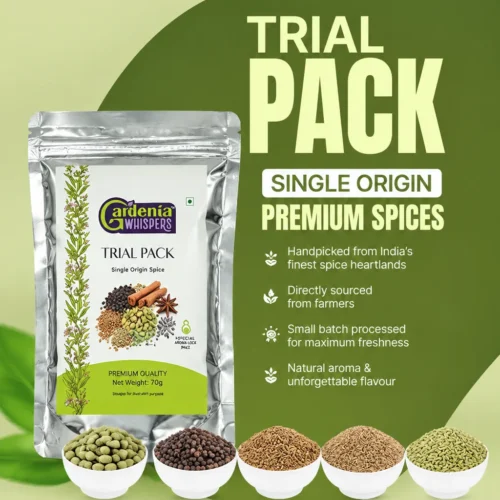
If you want to experience verified single-origin spices across multiple varieties, our Single-Origin Trial Pack is a practical starting point. Browse the full range at our shop. For sourcing detail on any product, visit our how we source page.
How to Identify Pure Spices: Frequently Asked Questions
What is the easiest home test to identify adulterated spices?
The palm rub test works for most whole spices and requires nothing but your hands. Take a teaspoon of whole seeds, place them in your palm, close your hand, and rub firmly for 10 seconds. A genuine, oil-rich spice releases a strong, defined aroma immediately and leaves it on your skin for several minutes. An adulterated or depleted spice releases very little or nothing. This works well for cumin, coriander, fenugreek, ajwain, and cardamom. For ground spices, the water settling test is the most accessible. Stir a teaspoon into a glass of water and leave for 3 minutes without stirring. Heavy adulterants like sand, chalk, and bark powder settle visibly at the bottom.
How do I test if my turmeric is pure at home?
Use the cold water test. Stir one teaspoon of turmeric into a glass of cold water and watch for 2 minutes without stirring again. Pure turmeric disperses slowly and settles naturally at the bottom. Adulterated turmeric with synthetic dyes like Lead Chromate or Metanil Yellow releases vivid colour streaks into the water almost immediately, spreading visibly before settling. For Metanil Yellow specifically, add two drops of hydrochloric acid to a small amount dissolved in water. If the mixture turns pink or magenta, Metanil Yellow is present. Pure turmeric does not turn pink with this test. The most reliable long-term protection is buying single-origin turmeric from a traceable, lab-tested source rather than relying on home tests alone.
How can I tell if my cinnamon is real Ceylon cinnamon or cassia?
Look at the cut end of the stick. Ceylon cinnamon has multiple thin, papery layers rolled tightly together in the cross-section, like a rolled newspaper. Cassia has a single thick, hard scroll with almost no interior layers. This difference is unmistakable once you see both. Press the stick between your fingers. Ceylon cinnamon is brittle and crumbles easily. Cassia is hard and requires significant force to break. This matters because cassia contains 1 to 12 percent coumarin compared to 0.004 percent in genuine Ceylon cinnamon. For regular daily consumption or therapeutic doses, cassia's coumarin content carries a documented risk of liver toxicity. Gardenia Whispers sources genuine Ceylon cinnamon from Sri Lanka and sells it separately from Manipur Cassia Cinnamon, clearly labelled as two different products. Read more in our cinnamon powder uses guide.
What are the most dangerous adulterants found in Indian spices?
Lead Chromate in turmeric is the most documented dangerous adulterant. It is a carcinogenic compound used to intensify colour in low-quality turmeric. FSSAI surveillance has found it consistently in market samples. Metanil Yellow, also found in turmeric, is a banned carcinogenic synthetic dye. Sudan Red, found in chilli powder, is another banned carcinogenic dye. Argemone seeds mixed into mustard contain toxic alkaloids called sanguinarine and dihydrosanguinarine. For cloves and nutmeg, the risk is exhausted product where the essential oils have been commercially extracted and the depleted material sold as genuine. These are not rare exceptions. FSSAI surveillance data places adulteration rates at 20 to 65 percent across common spice categories in the Indian retail market.
Can whole spices be adulterated or is it only ground spices that are at risk?
Whole spices can be adulterated, though it is usually easier to detect than in ground spices because the visual markers are still intact. Common whole spice adulterations include grass seeds mixed into cumin, dried papaya seeds mixed into black pepper, exhausted cloves mixed into genuine clove batches, empty or low-fill pods mixed into cardamom, and cassia sold without species disclosure. Ground spices are more at risk because grinding removes the visual markers that allow you to identify a spice, making fillers, dyes, and substitutions far harder to detect without laboratory testing.
What does NABL-accredited testing mean for spice purity?
NABL stands for National Accreditation Board for Testing and Calibration Laboratories, a Government of India body. It accredits laboratories against ISO/IEC 17025:2017, the international standard for laboratory technical competence. NABL-accredited test reports are the only ones accepted by FSSAI, BIS, and APEDA for food safety regulatory compliance in India. For spice testing, NABL-accredited testing covers compound content verification including cuminaldehyde in cumin, curcumin in turmeric, piperine in black pepper, and eugenol in cloves. It also covers synthetic dye detection at trace levels, heavy metal screening for lead, arsenic, cadmium, and mercury, pesticide residue against Maximum Residue Limits, and physical purity. It is the difference between a brand checking its own product and having it independently verified by a qualified third party. Read more on our certifications page.
How do I test if my asafoetida is genuine?
Smell is the first and most reliable test. Genuine high-resin asafoetida has an extremely pungent, persistent, sulphurous aroma that fills the room when you open the packet. Low-resin compounded hing, which may contain as little as 2 to 5 percent actual resin against the standard 30 to 40 percent, has a noticeably milder smell. For raw hing resin, the burn test is definitive. Hold a small piece over a spoon and bring a small flame near it. Genuine asafoetida resin catches fire quickly and burns with a bright, steady flame. Heavily adulterated material does not burn cleanly or leaves a thick dark residue. Check the label of any compounded hing for the resin content percentage. A brand that does not disclose this cannot verify its purity claim. Our Raw Asafoetida is resin-form hing without wheat flour or starch carriers.
Is it possible to fully verify spice purity at home without laboratory testing?
Home tests are a reliable first filter for gross adulteration. The water test, palm rub test, burn test for hing, and visual shape tests for whole spices catch the most common and large-scale forms of adulteration without any equipment. However, home tests cannot detect synthetic dyes at sub-visual concentrations, pesticide residue, heavy metals, or precise compound content levels. A turmeric that passes the cold water test may still have low curcumin content. A cumin that passes the visual shape test may still have depleted cuminaldehyde. Laboratory testing is the only method that verifies what the spice actually contains at a compound level, not just what it does not visibly contain. Read about the 230-parameter testing Gardenia Whispers uses before confirming any farmer on our quality promise page. If you want to start with verified single-origin spices, our Single-Origin Trial Pack is a practical starting point.
References
FSSAI Food Safety and Standards Authority of India. Surveillance and Enforcement Reports on adulteration rates across spice categories in the Indian retail market. Available at: www.fssai.gov.in
FSSAI Food Safety and Standards Authority of India. Compendium of Methods of Analysis: Spices and Condiments. Covers prescribed detection methods for turmeric, cumin, coriander, black pepper, cinnamon, asafoetida, and fenugreek including the HCl test for Metanil Yellow and water settling tests. Available at: www.fssai.gov.in/cms/compendium.php
Parthasarathy, V.A., Chempakam, B., and Zachariah, T.J. (Eds.) (2008). Chemistry of Spices. CAB International. Primary source for volatile oil composition, compound percentage data (cuminaldehyde, eugenol, piperine, 1,8-cineole, thymol, myristicin, anethole, thymoquinone), and sensory characteristics across major Indian culinary spice varieties.
Geographical Indications Registry of India. GI Application No. 18: Malabar Black Pepper. GI Application No. 19: Malabar Cardamom (Idukki). GI Application No. 637: Lakadong Turmeric. Intellectual Property India, Government of India. Full list available at: List of Geographical Indications in India
European Food Safety Authority (EFSA). Scientific Opinion on Coumarin in Food. Documents coumarin content differences between Ceylon cinnamon (Cinnamomum verum) and Cassia (Cinnamomum cassia) and associated health implications from regular consumption. Reference: EFSA Journal 2008: 793. Available via PubMed: pubmed.ncbi.nlm.nih.gov/16857695/
NERAMAC North Eastern Regional Agricultural Marketing Corporation Limited, Government of India. Documentation on Lakadong Turmeric curcumin content and GI-tagged status from Meghalaya. Available at: neramac.com/product/lakadong-turmeric/
Spices Board of India. Quality standards, GI-tagged spice varieties, and cultivation region documentation for major Indian spice categories. Available at: indianspices.com
Indian Cardamom Research Institute (ICRI), Myladumpara, Idukki, Kerala. Research institution under the Spices Board of India documenting altitude-quality relationship and 1,8-cineole content in Idukki cardamom. Affiliated with the Spices Board at: indianspices.com