Why Indian Spices Taste Different: Understanding Terroir, Climate and Origin

Two packets of jeera sit on your kitchen counter. Both say cumin seeds on the label. Both look roughly the same, brownish and ridged. You grind a pinch of each, and that is when everything changes. One smells flat, generic, a little dusty. The other fills the room. Deep and warm, almost nutty, with a sharpness that hits the back of your nose before you have even brought it close to the pan. Same spice, same name. Completely different experience.
If you have ever wondered why indian spices taste different from one packet to the next, the answer is not about the brand or the price tag. It is about where the spice grew, what the soil was made of, how much rain fell, how high the farm sat, and how many hours of sun the plant received each day. In the wine world, they have a word for this: terroir. And while nobody uses that term in your kitchen, the same science applies to the masale in your dabba.
This guide breaks down how origin shapes every aspect of a spice's flavour, aroma, and potency. You will learn what terroir means for spices, why the soil in Meghalaya's Jaintia Hills produces turmeric with 7 to 9% curcumin while turmeric from other regions barely reaches 3%, and how to choose spices based on where they come from rather than just what is printed on the packet. For a broader foundation on building your masala collection, start with our complete Indian spice guide.
What Is Terroir and Why Does It Apply to Spices?
Terroir is a French term originally used in winemaking. It refers to the complete natural environment in which a crop grows: the soil, the altitude, the rainfall, the temperature, and the surrounding biodiversity. All of these factors work together to shape the final character of what the plant produces. Two vineyards separated by a single hill can produce grapes with noticeably different flavour profiles. The same principle applies to spice plants, even though nobody talks about it in those terms at the sabzi mandi.
The concept of terroir for spices is relatively new in everyday language, but the science behind it is not. A black pepper vine grown at 800 metres in the Western Ghats develops different levels of piperine than one grown at 200 metres in the plains. Same vine. Completely different bite in your dal. The chemistry changes because the environment changes.
In wine, terroir is celebrated and priced accordingly. In the spice industry, these same differences get erased. Most commercial spices are sourced as commodities: farms across multiple regions blended together, processed in bulk, sold under generic labels. The result is consistent "nothing special." You get a spice that tastes like an average of everywhere rather than the best of somewhere. That is why your mummy's jeera from 20 years ago seemed to have more punch. It probably did, because back then, chances are it came from one place.
This is exactly what single origin spices challenge. When a spice is sourced from a specific region, from identified farms, and processed without blending, you taste the terroir of that place. For a deeper look at why single origin sourcing changes everything, read our single origin spices guide.
How Climate Shapes Spice Chemistry

You know how mangoes from Ratnagiri taste different from mangoes grown in UP? Same fruit, different climate, different result. The exact same thing happens with spices. Rainfall, temperature swings, humidity, and sunlight all directly shape how much flavour a spice develops on the plant.
Rainfall and Humidity
Spices grown in regions with heavy, well-distributed monsoon rainfall tend to develop higher concentrations of essential oils, the delicate compounds that carry flavour and aroma. These are the ones that escape easily, which is why fresh spices smell so much stronger. Kerala receives 2,500 to 3,000 mm of rainfall annually, and this consistent moisture is one reason why Kerala spices like cardamom, pepper, and mace smell so intensely aromatic the moment you open the jar. Too much humidity after harvest, though, can cause mould and spoilage. Getting the balance right between monsoon growing and careful drying is exactly why where a spice is processed matters as much as where it is grown.
Temperature and Seasonal Variation
Here is something interesting. When nights are cool and days are hot, plants build up more of the compounds that create aroma and pungency. They do this as a natural stress response. This is why spices from regions with big temperature swings often have stronger flavour profiles than spices from mild, consistent climates.
Jodhpur cumin is a perfect example. The Thar Desert sees scorching days and cool nights. Cumin grown in this climate develops 2.5 to 4.5% essential oil content, with high levels of cuminaldehyde, the compound that gives jeera its warm, earthy aroma. That is why a tadka made with Jodhpur cumin smells different from one made with generic jeera. The cumin did not just grow differently. It grew in a place that pushed it to develop more flavour.
Sunlight and Growing Season Length
Spices that need long, bright growing seasons, like fenugreek and fennel, thrive in Rajasthan's relentless sunshine. Shade-loving spices like cardamom and pepper grow best under the forest canopy in Kerala and Karnataka, where dappled light creates the ideal balance. Each spice evolved in a specific kind of environment, and the best versions come from places that match those original conditions. This is not marketing. It is why your nani's elaichi from Kerala smelled different from the elaichi you buy from a random packet today.
The Role of Soil in Spice Flavour

Nobody talks about dirt when they talk about spices. But the soil a spice grows in quietly determines everything. Think about it like this: two pots of tulsi on two different balconies taste slightly different, even when they get the same water and sunlight. The soil changes what the plant can absorb, and that changes what it produces.
Soil pH and Mineral Availability
The acidity or alkalinity of the soil determines which nutrients roots can absorb, and those nutrients feed the production of flavour compounds. The volcanic, acidic soils of Meghalaya's Jaintia Hills, with a pH of 4.5 to 5.5, create conditions that research suggests support higher curcumin production in turmeric. Lakadong turmeric from this region consistently measures 7 to 9% curcumin content, compared to 2 to 3% in turmeric from alluvial plains. Put both in your haldi doodh and you will see the difference in the cup before you taste it.
This connection between soil and spice potency is backed by laboratory analysis, the same kind of testing discussed in our spice adulteration and lab testing guide. Different soil, different chemical profile, different flavour in your food.
Soil Type and Drainage
The physical structure of soil matters too. Well-drained iron-rich soils in Kerala let cardamom and pepper roots breathe without waterlogging. Sandy loam soils in Rajasthan force cumin and fennel to push deeper roots, pulling up minerals unavailable in topsoil. These heritage spice-growing regions have had centuries of natural soil development. The organic matter, microbial diversity, and mineral balance built up over generations cannot be replicated by simply planting the same variety somewhere else. That is why transplanting Lakadong turmeric to a different state does not reproduce the same 7 to 9% curcumin. The haldi needs its home soil.
Altitude: Why Growing Higher Up Changes Everything
If you have ever trekked in the hills and noticed that the chai at a mountain stall hits different, altitude is part of the reason. Every 100-metre climb brings a drop in temperature, more UV exposure, and thinner air. Plants respond to this stress the way we respond to cold weather: they toughen up. In a plant's case, "toughening up" means producing more of the compounds that we experience as flavour, aroma, and heat.
Idukki cardamom grows at 600 to 1,400 metres in the Western Ghats. At this height, cooler temperatures and stronger sunlight push the plant to produce more 1,8-cineole (the compound that gives cardamom its cooling, almost mentholated freshness) and alpha-terpinyl acetate (the sweet, floral note you catch in a good elaichi chai). Cardamom grown lower down, even from the same plant variety, develops a flatter flavour profile with around 4 to 5% essential oil content versus the 6 to 8% in well-grown Idukki pods. You notice this the moment you crack a pod open. The high-altitude one fills the room. The lowland one barely registers.
The same applies to Malabar black pepper. Pepper vines at moderate heights in Kerala's Wayanad and Idukki districts develop among the highest piperine concentrations found globally, ranging from 5 to 9%. That is what gives your kali mirch its bite. Pepper from low-altitude, irrigated plantations may look identical but delivers noticeably less heat in your food.
| Spice | Key Compound | Grown High Up (600m+) | Grown in Plains (Below 200m) |
|---|---|---|---|
| Cardamom | 1,8-Cineole (essential oil) | 6 to 8% essential oil | 4 to 5% essential oil |
| Black Pepper | Piperine | 5 to 9% | 3 to 5% |
| Turmeric | Curcumin | 7 to 9% (Lakadong) | 2 to 3% (plains varieties) |
| Cloves | Eugenol | 80 to 90% of essential oil | 70 to 80% of essential oil |
The Science Behind Spice Flavour: Key Compounds and Where They Come From

When you bite into a peppercorn and feel the heat, that is piperine. When haldi turns your golden milk that deep, staining yellow, that is curcumin. When laung numbs your aching tooth, that is eugenol. Every spice flavour you have ever experienced in your kitchen is the result of specific chemical compounds, and the concentration of those compounds depends heavily on where the spice grew.
You do not need a chemistry degree for this. You just need to understand why one haldi transforms your dal while another barely colours the water, why one kali mirch makes you sneeze while another sits there doing nothing. Here are the compounds that matter most and the regions that produce them in the highest concentrations.
Curcumin in Turmeric
Curcumin is the primary bioactive compound in turmeric, responsible for its colour, its studied health properties, and its characteristic earthy-bitter flavour. Most turmeric sold in Indian markets contains 2 to 3% curcumin. Lakadong turmeric from the Jaintia Hills of Meghalaya measures 7 to 9% curcumin, a difference you can see with your eyes (deeper, richer colour) and taste on your palate (more complex, warmer bitterness). This is the same turmeric cherished in haldi doodh and traditional remedies. For a detailed look at haldi ke fayde, we have a separate guide.
Piperine in Black Pepper
Piperine is the compound that creates black pepper's heat. It also helps your body absorb other nutrients better, which is why haldi-kali mirch is such a powerful combination in Indian cooking. Malabar pepper from Kerala's Western Ghats develops among the highest piperine levels globally, ranging from 5 to 9% depending on how high up it grows and how it is processed. Pepper from flat, irrigated farms in other regions typically falls between 3 and 5%. When your masala chai hits the back of your throat with real warmth, that is high-piperine pepper doing its job.
Eugenol in Cloves
Eugenol is what makes cloves cloves. It is the compound responsible for their warming, slightly numbing, deeply aromatic character. It is also the active ingredient in the age-old cloves for toothache remedy and the reason clove oil is used in traditional medicine. Cloves from Tamil Nadu's southern coast develop eugenol concentrations of 80 to 90% of their essential oil content, thanks to the unique microclimate created by coastal humidity and the specific iron-rich soils of the region.
Cuminaldehyde in Cumin
Cuminaldehyde is the signature aroma compound in cumin, responsible for its warm, earthy, slightly peppery aroma. It is what makes your tadka smell like home. Jodhpur cumin from Rajasthan's arid climate develops high concentrations of this compound because the plant responds to heat stress and dry conditions by producing more essential oils. This is why Jodhpur cumin tastes markedly different from commodity cumin blended from multiple origins.
1,8-Cineole in Cardamom
1,8-Cineole gives cardamom its characteristic cooling freshness. It is the first aroma that hits you when you crack open a green cardamom pod from Idukki. Combined with alpha-terpinyl acetate (the sweet note) and other aroma compounds, it creates the complex flavour that makes cardamom indispensable in both elaichi kheer and savoury dishes. The difference between a cardamom that fills the room when you open the jar and one that barely registers is almost entirely about where it was grown and how it was dried.
| Compound | Found In | Best Region | What It Does |
|---|---|---|---|
| Curcumin | Turmeric | Meghalaya (Jaintia Hills) | Colour, earthy warmth, studied health properties |
| Piperine | Black Pepper | Kerala (Western Ghats) | Heat, nutrient absorption enhancer |
| Eugenol | Cloves | Tamil Nadu (Southern Coast) | Warming aroma, numbing sensation |
| Cuminaldehyde | Cumin | Rajasthan (Jodhpur/Thar) | Warm, earthy, peppery aroma |
| 1,8-Cineole | Cardamom | Kerala (Idukki) | Cooling freshness, minty note |
| Cinnamaldehyde | Cinnamon / Cassia | Sri Lanka / Manipur | Warm, sweet heat |
| Capsaicin | Chillies | Rajasthan (Mathania) | Heat, pungency |
Regional Spice Profiles: India's Flavour Map
India is not one growing region. It is dozens. From the arid deserts of Rajasthan to the tropical forests of Kerala, from the volcanic hills of Meghalaya to the coastal plains of Tamil Nadu, each region's soil, altitude, and monsoon pattern shapes spices that taste distinctly of that place. Think of it as India's flavour map, where every pin tells a different story on your palate.
Meghalaya: Lakadong Turmeric
The Jaintia Hills of Meghalaya sit at 1,000 to 1,500 metres, with volcanic-origin acidic soils, heavy rainfall, and cool temperatures that rarely exceed 25 degrees Celsius. The local Khasi and Pnar communities have cultivated turmeric here for generations using traditional methods with no synthetic inputs. This is haldi with a backstory that goes back centuries.
Lakadong turmeric from this region measures 7 to 9% curcumin, making it one of the most potent varieties in the world. Make a haldi doodh with this turmeric and you will notice the difference in the cup before you take a sip. The colour is deeper, richer, almost amber. The flavour has a warm complexity that generic haldi simply does not carry. You can explore its full range of benefits in our haldi ke fayde guide.
Kerala: Cardamom, Pepper, Mace, and Nutmeg
There is a reason Kerala has been called the Spice Garden of India since before the Portuguese showed up looking for pepper. The Western Ghats combine heavy rainfall (2,500 to 3,000 mm), heights up to 1,400 metres, iron-rich mineral soils, and a forest canopy that filters sunlight. This combination produces spices with an intensity that has drawn traders across oceans for centuries.
Idukki green cardamom from this region develops 6 to 8% essential oil content, with that bright, mentholated freshness that lifts a biryani, transforms a chai, and makes elaichi kheer unforgettable. Malabar pepper, grown on vines that climb the same forest trees, develops among the highest piperine concentrations found in black pepper globally. Idukki mace and nutmeg carry the warm, sweet complexity that made Kerala a destination on ancient trade routes. Explore the full Kerala spice collection to taste this terroir for yourself.
Rajasthan: Cumin, Fennel, Fenugreek, and Kasuri Methi
Rajasthan's Thar Desert seems like the last place you would expect world-class spices. Extreme heat, barely 250 to 500 mm of rain a year, sandy loam soils. And yet, this harsh environment produces some of India's finest dry-climate spices precisely because the stress forces plants to concentrate their essential oils. The spice fights harder to survive, and your kitchen benefits.
Jodhpur cumin develops 2.5 to 4.5% essential oil, with cuminaldehyde levels that make your tadka noticeably more fragrant than commodity cumin ever could. Jodhpur fennel and thin fennel have that sweet, anise-like complexity that makes Rajasthani saunf a post-meal essential. Jodhpur fenugreek and Mathania kasuri methi carry the distinctive bitter-sweet character central to Rajasthani cooking and the backbone of a good methi matar or dal fry. For a deeper look at how this region's cumin differs, read our Jodhpur cumin vs regular cumin comparison. Browse the full Rajasthan spice collection.
Tamil Nadu: Kanyakumari Cloves
Kanyakumari cloves come from the southernmost tip of India, where three seas converge. The coastal microclimate, with its humidity, steady temperatures, and iron-rich soils, creates conditions ideal for eugenol development in clove buds. Cloves from Tamil Nadu's southern coast reach eugenol concentrations of 80 to 90% of their essential oil, giving them that intense, warming punch that defines a good garam masala. Drop one into a pot of chai and you will know the difference immediately. Explore the broader Tamil Nadu collection.
Northeast India: Bay Leaf, Cassia, and More
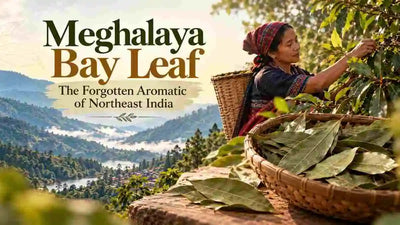
The Northeast Indian spice belt remains one of the most underexplored treasure troves. Meghalaya bay leaf grows wild in the region's forests, developing a more complex, multi-layered aroma than commercially farmed bay leaves. Manipur cassia cinnamon benefits from the region's subtropical climate and rich soils. For those interested in the differences between cinnamon varieties, our cinnamon powder uses and cinnamon in Hindi guides cover the topic in detail.
| Region | Key Spices | Terroir Factors | Result |
|---|---|---|---|
| Meghalaya (Jaintia Hills) | Lakadong Turmeric | Volcanic acidic soil, 1,000-1,500m altitude, heavy rainfall | 7 to 9% curcumin (vs 2 to 3% typical) |
| Kerala (Western Ghats) | Cardamom, Pepper, Mace, Nutmeg | Iron-rich soils, 600-1,400m, 2,500-3,000mm rainfall, forest canopy | 6 to 8% essential oil (cardamom), high piperine (pepper) |
| Rajasthan (Thar) | Cumin, Fennel, Fenugreek | Sandy loam, extreme heat/cool nights, 250-500mm rainfall | 2.5 to 4.5% essential oil (cumin), high cuminaldehyde |
| Tamil Nadu (Kanyakumari) | Cloves | Coastal microclimate, iron-rich soils, three-ocean convergence | 80 to 90% eugenol in essential oil |
| Northeast India | Bay Leaf, Cassia Cinnamon | Subtropical forests, rich organic soils, high rainfall | Complex multi-layered aroma, wild-grown character |
GI Tags and Why They Matter for Spice Origin
You have probably seen "GI Tagged" on products like Darjeeling tea or Banarasi silk. The same system exists for spices. A GI tag, short for Geographical Indication, is a legal certification from the Government of India that confirms a product comes from a specific region and has qualities tied to that origin. Think of it as a birth certificate for a spice.
Several Indian spices carry GI certification: Malabar Pepper (Kerala), Alleppey Green Cardamom (Kerala), Guntur Sannam Chilli (Andhra Pradesh), Bydagi Chilli (Karnataka), and Coorg Green Cardamom (Karnataka), among others. When you see a GI tag on a spice, it means someone has verified that the product actually came from where it claims.
But here is what a GI tag does not do. It does not certify purity, lab testing, pesticide-free status, or how the spice was processed after harvest. A GI tag tells you where it grew, not whether it was handled properly. This is why GI certification and independent batch-level quality testing work together. The strongest assurance comes when both are in place. Origin plus testing. That is the combination worth looking for.
Single Origin vs Commodity Spices: What You Actually Taste
Here is how the spice industry usually works. Traders buy from hundreds of farms across multiple districts, sometimes multiple states. Everything gets blended, processed in bulk, and sold under a brand name. This is done for consistency and cost. It is also the single biggest reason why most spices taste flat and forgettable.
Imagine mixing Darjeeling tea with generic dust tea. You get something that is technically tea but tastes like neither. The same thing happens with spices. When you blend turmeric from Meghalaya (7 to 9% curcumin) with turmeric from the plains (2 to 3% curcumin), you get haldi that tests at maybe 4%. Not bad, not exceptional. Just average. Your dal turns a tepid yellow instead of the deep gold your nani's dal used to be.
Single origin spices are the opposite. A single origin spice comes from one specific region, from identified farms or cooperatives. It is processed separately, without blending, so the terroir of that region comes through in the final product. You taste the place, not the average.
| Factor | Single Origin | Commodity Blend |
|---|---|---|
| Sourcing | One region, identified farms | Multiple regions, anonymous bulk |
| Processing | Small batch, region-specific | Large-scale industrial blending |
| Traceability | Farm to packet | Often untraceable beyond warehouse |
| Flavour | Distinctive, complex, region-specific | Flat, generic, averaged out |
| Compound Concentration | Higher (best of one region) | Lower (average of many) |
| Batch Testing | Traceable, testable per batch | Difficult to test meaningful samples |
The difference is not subtle. If you have cooked with properly sourced Lakadong turmeric or Jodhpur cumin, you already know that going back to a generic packet feels like cooking with the volume turned down. For those new to single origin, our trial pack is designed to let you experience the difference across multiple spices without committing to full-sized packets.
Harvest Timing, Processing, and Essential Oils
Terroir determines the potential of a spice. But harvest timing and processing determine how much of that potential actually reaches your dabba. Think of it like this: a mango can grow on the best tree in Ratnagiri, but if it is picked too early or left to sit in a truck for a week, it will not taste like it should. Spices work the same way.
Essential oils, the compounds that carry a spice's flavour and aroma, are delicate. They escape when exposed to heat, light, moisture, and air. Cardamom pods harvested at the right stage and shade-dried carefully retain their cooling 1,8-cineole. Pods picked too late, when they have already started splitting open, lose essential oils before drying even begins. Black pepper develops peak piperine when the berries are fully mature but still green. Farms that have grown pepper for generations know exactly when to pick for their specific microclimate. That knowledge is part of the terroir story too.
Processing matters just as much. Sun drying, shade drying, and mechanical drying all produce different results. Excessive heat during drying drives off the very compounds you are paying for. This is also why whole spices retain their potency longer than ground. A whole peppercorn or cumin seed locks in the flavour compounds until you grind it open in your kitchen, right before it goes into the pan.
At Gardenia Whispers, every packet carries a batch date so you know exactly when it was processed. This matters because freshness directly affects the concentration of essential oils in your spices. A spice with a clear batch date and traceable origin gives you the information you need to judge quality for yourself.
How to Choose Spices by Origin
Now that you know terroir, climate, soil, and altitude all shape spice quality, how do you actually use this knowledge when you are standing in a store or scrolling online? It is simpler than you think.
Ask where, not just what. The most important question about a spice is not "Is this pure?" but "Where did this grow?" If the label just says "turmeric powder" with no origin, that is almost certainly a commodity blend. A spice that names its region can back up its quality with actual data.
Look for a batch date. A brand that lists a batch date and can trace that batch to a specific region is operating very differently from one that just packages bulk inventory. Batch traceability is also the only way laboratory testing can be tied to the packet you are actually opening in your kitchen.
Do not rely on certifications alone. FSSAI licensing, HACCP, organic certification, GI tags: they all serve different purposes, but none of them individually guarantees that the spice in your packet is potent, fresh, or from a specific origin. They are pieces of the puzzle. What matters is whether the brand combines good sourcing with transparent processing and independent testing. Our certifications page explains what each one covers.
Buy whole, grind fresh. Whole spices are harder to adulterate and retain their essential oils far longer. For daily staples like jeera, kali mirch, and dhania, buy whole from traceable sources and grind at home. The difference in your tadka will be obvious from the first use.
Trust your nose, but verify with data. Aroma is a real quality indicator. If a spice smells flat when you open the packet, the essential oils have likely degraded. But your nose cannot tell you curcumin percentage or heavy metal levels. Sensory evaluation and lab testing work together. Neither replaces the other.
Kaise Pehchanein Asli Masale? (How to Identify Authentic Spices)
Asli masale ki pehchaan sirf rang ya smell se nahin hoti. Sabse pehle dekhein ki packet pe origin likha hai ya nahin. Agar sirf "turmeric powder" ya "jeera" likha hai bina kisi jagah ke naam ke, toh yeh zyaadatar commodity blend hota hai, matlab alag alag jagahon ka masala mila ke banaaya gaya hai.
Doosri cheez dekhein batch date. Agar packet pe batch date hai aur saath mein kaunsi jagah se aaya hai, toh yeh trace ho sakta hai. Teesri baat, lab testing reports mangein ya dekhein. Aaj kal kuch brands har batch ki testing report share karti hain, jismein heavy metals, pesticides, aur aflatoxin ke results hote hain. Aur haan, jab tak ho sake sabut masale khareedein aur ghar pe peesein, kyunki sabut masale mein milawat karna mushkil hai aur essential oils bhi zyaada preserve rehte hain.
Key Takeaways
1. Terroir (soil, altitude, rainfall, temperature) directly determines the concentration of flavour compounds in every spice.
2. The same spice variety grown in different regions produces measurably different levels of curcumin, piperine, eugenol, and other key compounds.
3. Single origin spices preserve regional terroir while commodity blends average it out, resulting in flatter, less potent flavour.
4. GI tags certify origin but not purity or testing; the strongest assurance combines traceable sourcing with independent batch-level lab testing.
5. Buying whole spices from known origins and grinding fresh at home gives you the most control over flavour and quality.
Conclusion
Why do Indian spices taste different? Because India is not one place. It is a patchwork of microclimates, soil types, altitudes, and growing traditions, each producing spices with distinct chemical fingerprints. The curcumin in your haldi, the piperine in your kali mirch, the eugenol in your laung, the cuminaldehyde in your jeera: all of these are shaped by the specific patch of earth where the plant grew and the specific conditions it experienced.
This is not marketing language. It is agricultural science, yes, but more importantly, it is something you can taste. When you choose a spice by its origin rather than just its name, you are choosing the terroir that produced it. And that is the difference between a masala that cooks food and a masala that transforms it. Your food deserves the best of somewhere, not the average of everywhere.
Start exploring the difference origin makes with our bestselling spice collection, or learn more about how we source directly from heritage growing regions across India.
Disclaimer: This article is for informational purposes only. The compound percentages and regional data cited are based on published agricultural research and laboratory analyses. Individual batch results may vary depending on specific growing conditions, harvest timing, and processing methods. Spice compound percentages (curcumin, piperine, eugenol, etc.) are not standardised across the industry, and different testing methodologies may produce different results. References to health properties of spice compounds describe findings from published research and are not intended as medical advice. Always consult a qualified healthcare professional for health-related decisions. For information about our specific testing and quality standards, visit our quality promise and certifications pages.
Frequently Asked Questions
What is terroir and how does it apply to spices?
Terroir is a term borrowed from winemaking that refers to the complete natural environment where a crop grows, including soil composition, altitude, rainfall, temperature, and microclimate. The same concept applies to spices: a black pepper vine grown at 800 metres in Kerala's Western Ghats produces different piperine levels than one grown at 200 metres in the plains. The vine may be genetically identical, but the chemistry of the final product changes because the growing environment is different.
Why does the same spice taste different from different brands?
Most brands sell commodity blends, mixing spices from many regions to achieve a consistent but averaged-out product. The flavour differences you notice come from terroir: different growing regions produce different concentrations of key flavour compounds like curcumin, piperine, or cuminaldehyde. A brand using single origin spices from a high-quality growing region will taste noticeably different from one selling a multi-region blend.
What makes Lakadong turmeric different from regular turmeric?
Lakadong turmeric from Meghalaya's Jaintia Hills contains 7 to 9% curcumin, compared to 2 to 3% in most turmeric sold commercially. This difference is because of the region's volcanic acidic soils (pH 4.5 to 5.5), high altitude (1,000 to 1,500 metres), heavy rainfall, and traditional farming methods practiced by local communities for generations.
Does altitude really affect spice quality?
Yes, measurably. Higher altitudes bring cooler temperatures, increased UV exposure, and lower oxygen levels. Plants respond to these stresses by producing more flavour compounds. For example, cardamom grown at 600 to 1,400 metres in Idukki develops 6 to 8% essential oil content, while cardamom grown lower down typically reaches only 4 to 5%.
What is the difference between single origin and commodity spices?
Single origin spices come from one specific region and are processed without blending, so you taste the terroir of that place. Commodity spices are sourced from multiple regions, blended for consistency, and sold under generic labels. The blending averages out the compound concentrations, resulting in a product that tastes like an average of everywhere rather than the best of somewhere. Single origin also enables batch-level traceability and meaningful lab testing.
What does a GI tag mean for spices?
A Geographical Indication (GI) tag is a legal certification under Indian law that verifies a product originates from a specific geographic region and has qualities tied to that origin. For spices, GI tags like Malabar Pepper or Alleppey Green Cardamom certify where the spice was grown. However, a GI tag does not certify purity, lab testing results, or processing quality. It confirms origin, not handling.
How does soil pH affect turmeric's curcumin content?
Research suggests that soil acidity influences how turmeric plants produce curcumin. The volcanic, acidic soils of Meghalaya's Jaintia Hills (pH 4.5 to 5.5) create conditions linked to higher curcumin production. Turmeric grown in neutral or alkaline river-plain soils typically produces lower curcumin levels. This is an area of active agricultural research, but the measurable differences between regions are well documented.
Why are Kerala spices considered among the best in the world?
Kerala's Western Ghats combine high rainfall (2,500 to 3,000 mm), moderate to high altitude, iron-rich mineral soils, and shaded forest canopy conditions. This creates ideal growing conditions for cardamom, pepper, mace, nutmeg, and other spices. The combination of consistent moisture during growing season, cool mountain temperatures, and mineral-rich soils produces spices with exceptionally high essential oil concentrations and complex flavour profiles.
How can I tell if my spices are high quality?
Look for three things: origin information (the label should name a specific region), a batch date (so you know when it was processed), and evidence of testing (brands that test each batch can share reports showing compound levels and safety data). Aroma is also a practical indicator: a high-quality spice will have a strong, distinctive smell when you open the packet. For more detailed checks, our guide to identifying pure spices covers both sensory and scientific methods.
What is piperine and why does it matter in black pepper?
Piperine is the compound that gives black pepper its characteristic heat and bite. It also helps your body absorb other nutrients better, which is why the traditional haldi-kali mirch combination works so well together. Malabar pepper from Kerala develops among the highest piperine levels globally (5 to 9%), while pepper from lower regions typically measures 3 to 5%. Higher piperine means more heat, better nutrient absorption, and a more effective pepper.
Masalon mein terroir ka matlab kya hota hai?
Terroir ek French shabd hai jo wine ki duniya se aaya hai. Iska matlab hai ki jis jagah pe fasal ugti hai, wahan ki mitti, paani, uunchaai, temperature, aur mausam, sab milke uski quality tay karte hain. Masalon mein bhi yahi hota hai. Meghalaya ki pahaadiyon mein ugne wali haldi mein 7 se 9% curcumin hota hai, jabki maidaani ilaake ki haldi mein sirf 2 se 3%. Ek hi haldi hai, lekin jagah alag hai toh swaad aur taakat dono alag ho jaate hain.
Single origin masale kyun behtar hote hain?
Zyaadatar brands alag alag jagahon ke masale mila ke bechti hain, jisse ek average swaad aata hai. Single origin masale ek hi jagah se aate hain, bina mixing ke, toh aapko us jagah ki khaas mitti, paani, aur mausam ka asli swaad milta hai. Iske alawa, single origin masalon ko batch level pe trace kiya ja sakta hai aur har batch ki lab testing bhi ho sakti hai. Yahi wajah hai ki ek achcha single origin jeera aapke tadke ko bilkul alag bana deta hai.